


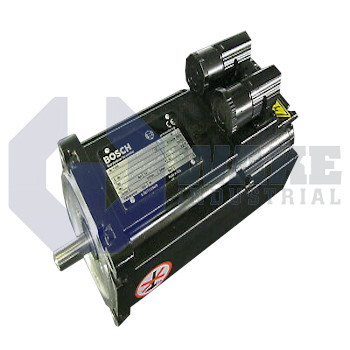
SF-A3.0068.030-00.210 Bosch Rexroth Indramat
Wake Industrial LLC is not an authorized distributor of this product.
MPN: 1070076373
No Tariffs On US Orders- Straightforward Pricing: No Rush Fees, No Credit Card Fees
The Bosch Rexroth Indramat SF-A3.0068.030-00.210 is a servo motor in the SF Servo Motors series, featuring an absolute value encoder and a flange size of 116 mm. It has a rated speed of 3000 min^-1 and a locked-rotor torque of 6.8 Nm. The construction type is IM B5, and its DC link voltage is 670 V.


To contact sales for pricing and lead time:
Payment Methods


Shipping Methods


Our Credentials


Product Description:
The SF-A3.0068.030-00.210 is a servo motor produced by Bosch Rexroth Indramat within the SF Servo Motors series. This rotary unit converts controlled electrical power into torque for positioning, speed control, and cyclic tasks in industrial automation lines. Its electrical interface matches DC-link supplied drive controllers used in Rexroth multi-axis systems, allowing the motor to fit directly into synchronized motion groups on packaging, handling, and assembly equipment.
The motor delivers a rated shaft speed of 3000 rpm, enabling direct coupling to gearless machinery that calls for moderate top velocities. A torque constant of 1.36 Nm/A indicates how much mechanical torque is produced per ampere, which helps size the amplifier current. The winding is intended for a bus voltage of 670 V, so the connected inverter must supply that DC-link voltage during dynamic cycles. During startup with the rotor locked, the stator can generate 6.8 Nm while drawing up to 5.0 A. Rotor position is reported by an absolute encoder, allowing immediate position feedback after power restoration without homing moves. Two NTC thermistors embedded in the windings supply temperature data to shut down the drive if limits are exceeded.
The mechanical design follows the IM B5 mounting code, meaning a flange face with through-holes carries axial loads while keeping the frame compact. That flange measures 116 mm, so mating gearboxes or brackets must match this pilot diameter. Continuous operation is permitted at ambient temperatures up to 40 °C, while the internal sensor logic trips at a winding temperature of 155 °C to help prevent insulation damage. The dual thermistor arrangement provides redundancy, and the absolute encoder maintains position data even if power is cycled, reducing system recovery time.