


SF-A3.0042.030-04.053 Bosch Rexroth Indramat
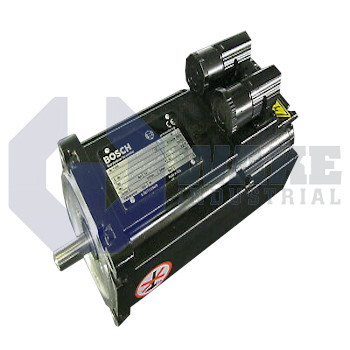
Wake Industrial LLC is not an authorized distributor of this product.
MPN: 1070082194
No Tariffs On US Orders- Straightforward Pricing: No Rush Fees, No Credit Card Fees
The Bosch Rexroth Indramat SF-A3.0042.030-04.053 is part of the SF Servo Motors series and has a flange size of 116 mm and a shaft size of 19 by 40 mm. This motor provides a holding torque of 10 Nm and a rated speed of 3000 min^-1, with a mass of 7.0 kg without a brake. It operates with a brake supply voltage of 24 VDC and a torque constant of 1.6 Nm per Amp.


To contact sales for pricing and lead time:
Payment Methods


Shipping Methods


Our Credentials


Product Description:
The SF-A3.0042.030-04.053 is a synchronous servo motor produced by Bosch Rexroth Indramat within the SF Servo Motors series. This unit converts drive current into controlled rotary motion for positioning axes, feeders, and similar automation modules that require repeatable velocity and torque. It is suited for automated equipment that needs accurate starts, stops, and stable speed control during repeated cycles. Its synchronous design also supports precise response to changing command signals in indexing, handling, and transfer applications.
The motor mounts to machinery with a square flange measuring 116 mm, and power is transmitted through a precision-ground shaft sized at Ø19 × 40 mm. The housing length is 223 mm, and the motor has a mass of 7.0 kg, which helps it fit into compact multi-axis assemblies. Rotor inertia is 7 × 10⁻⁴ kg·m², which helps smooth acceleration changes and supports stable tuning in the connected drive. Rated operation reaches 3000 rpm, allowing consistent speed in feed, transfer, and indexing duties. The square flange and shaft geometry support direct coupling to common machine elements such as pulleys, couplings, and small gearbox inputs.
The brake is energized from 24 VDC and draws a steady coil current of 0.66 A, which suits standard control power supplies. During startup, the winding can accept a locked-rotor current of 2.3 A and produce a locked-rotor torque of 3.7 Nm until rotation begins. When the brake is applied, it provides a continuous holding torque of 10.0 Nm for static load retention. The torque constant is 1.6 Nm/A, so motor current scales linearly with developed torque during closed-loop control. That behavior helps the drive maintain predictable torque output during low-speed moves, short positioning steps, and standstill control.









