


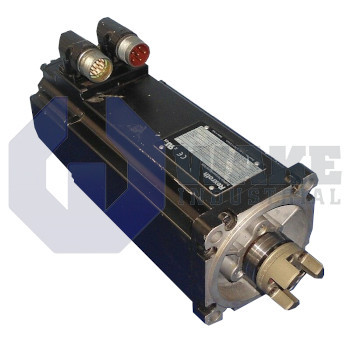
SF-A2.0041.060-14.050 Bosch Rexroth Indramat
Wake Industrial LLC is not an authorized distributor of this product.
Wake Industrial LLC is not an authorized distributor of this product.
MPN: 1070076889
The Bosch Rexroth Indramat SF-A2.0041.060-14.050 is part of the SF Servo Motors series and features a rated speed of 6000 rpm with a holding brake torque of 3.2 Nm. This servo motor has a torque constant of 0.73 Nm per amp and supports a shock resistance of 6 g. It is constructed in the IM B5 configuration and supports an admissible axial force of 70 Newtons.
Internal Product Review
The SF-A2.0041.060-14.050 is a Bosch Rexroth Indramat SF servo motor that stands out with 6000 min^-1 rated speed and 4.0 Nm locked-rotor torque. The 24 VDC brake and 3.2 Nm holding torque support dependable positioning, making this model a strong choice for fast, controlled motion.
 Have a part to sell?
 Wake Industrial Warranty
To contact sales for pricing and lead time:
Payment Methods


Shipping Methods


Our Credentials


Product Description:
Bosch Rexroth Indramat’s SF-A2.0041.060-14.050 is a servo motor from the SF Servo Motors series that delivers rotational motion for positioning, feed, and spindle axes in automated machinery. The motor converts drive current into controlled torque and speed for precision actuation, providing a compact IM B5 flange-mounted solution that suits tight mechanical layouts and standard industrial mounting patterns. Its integrated spring-applied holding brake secures the shaft when power is removed, which makes the unit suitable for vertical loads and other axes that must remain in place at standstill.
At full excitation, the motor reaches a rated speed of 6000 rpm, allowing fast positioning cycles. A torque constant of 0.73 Nm/A shows the relationship between phase current and produced torque, which helps keep current control easy to interpret. Dynamic response is supported by the low rotor inertia of 6 × 10⁻⁴ kg·m², while the brake inertia adds only 0.4 × 10⁻⁴ kg·m², so stopping does not place significant kinetic energy on the brake assembly. The assembly withstands impacts up to 6 g, meeting common machine tool shock requirements. During startup or jam conditions, the shaft can deliver a locked-rotor torque of 4.0 Nm and draws a corresponding locked-rotor current of 5.6 A to overcome static load or friction.
The spring-applied brake holds the shaft with 3.2 Nm of static torque and is energized by a supply of 24 VDC. Its release timing includes a 19 ms mechanical delay and a 29 ms separation time, so the control system can allow a brief pause before motion begins. The coil requires only 0.56 A during continuous holding, which helps limit power dissipation inside the enclosure. An admissible axial force of 70 N helps protect the bearings against thrust loads that can occur in belt-driven or vertical screw assemblies. These operating limits should be observed when the motor is connected to external transmission elements.









