


RZS01.1-5-130 Bosch Rexroth Indramat
Wake Industrial LLC is not an authorized distributor of this product.
Wake Industrial LLC is not an authorized distributor of this product.
MPN: R911200771
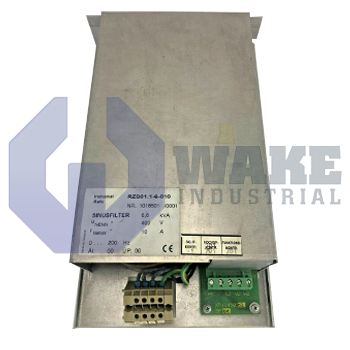
Ask for AvailabilityThe Bosch Rexroth Indramat RZS01.1-5-130 is a sinusoidal filter from the RZS Sinusoidal Filters series. It operates with a connecting voltage of 3 x AC 500 V and supports a frequency range from 0 to 100 Hz. The filter handles a nominal current of 130 A and has a power loss of 640 W, with a pulse frequency of 8 kHz.
Internal Product Review
The RZS01.1-5-130 is a Bosch Rexroth Indramat sinusoidal filter built for 3 x AC 500 V operation. Compatibility with 090 / 110 converter power classes and an 8 kHz pulse frequency make integration straightforward in demanding drive systems. Excellent electrical matching and a 130 A nominal current make the unit a very capable filtering solution.
 Have a part to sell?
 Wake Industrial Warranty
To contact sales for pricing and lead time:
Payment Methods


Shipping Methods


Our Credentials


Product Description:
The RZS01.1-5-130 sinusoidal filter is built by Bosch Rexroth Indramat as part of the RZS Sinusoidal Filters series. Designed for the AC output stage of frequency converters, the filter smooths the pulsed voltage waveform so that the motor terminals see a near-sinusoidal profile. By limiting voltage rise times and common-mode noise, it protects motor insulation and reduces conducted emissions in industrial automation cabinets that rely on long motor cables or operate sensitive sensors nearby. It mounts between the drive and the motor and serves as a passive LC network tuned for the converter’s switching characteristics. This placement is useful when cable length and fast switching edges would otherwise increase stress on connected motor windings.
Electrically, the unit is rated for a line-to-line connection of 3 x AC 500 V. A permissible mains deviation of ±10 % allows continued operation during moderate supply fluctuations. A continuous phase current of 130 A is the thermal current rating for the inductor windings, while a switching pulse frequency of 8 kHz matches the filter’s inductance and capacitance to the converter output. Internal iron and copper losses sum to 640 W, so the enclosure must be installed in a panel with forced-air cooling to keep component temperatures within the insulation class. Because this heat is continuous under load, cabinet airflow also needs to prevent hot spots around nearby power devices.
On the dynamic side, the filter passes a fundamental frequency span of 0 … 100 Hz and therefore supports variable-speed operation from standstill through the converter’s nominal speed. Compatibility with converter power classes 090 / 110 simplifies drive selection in modular cabinet designs. The documented design release of 1 aligns with Product Line 01 hardware profiles. The filter supports rapid inverter-controlled acceleration ramps without distorting the sinusoidal voltage delivered to induction or synchronous machines. It is intended for use between the drive and the motor where PWM output must be smoothed before it reaches the cable and motor terminals.









