


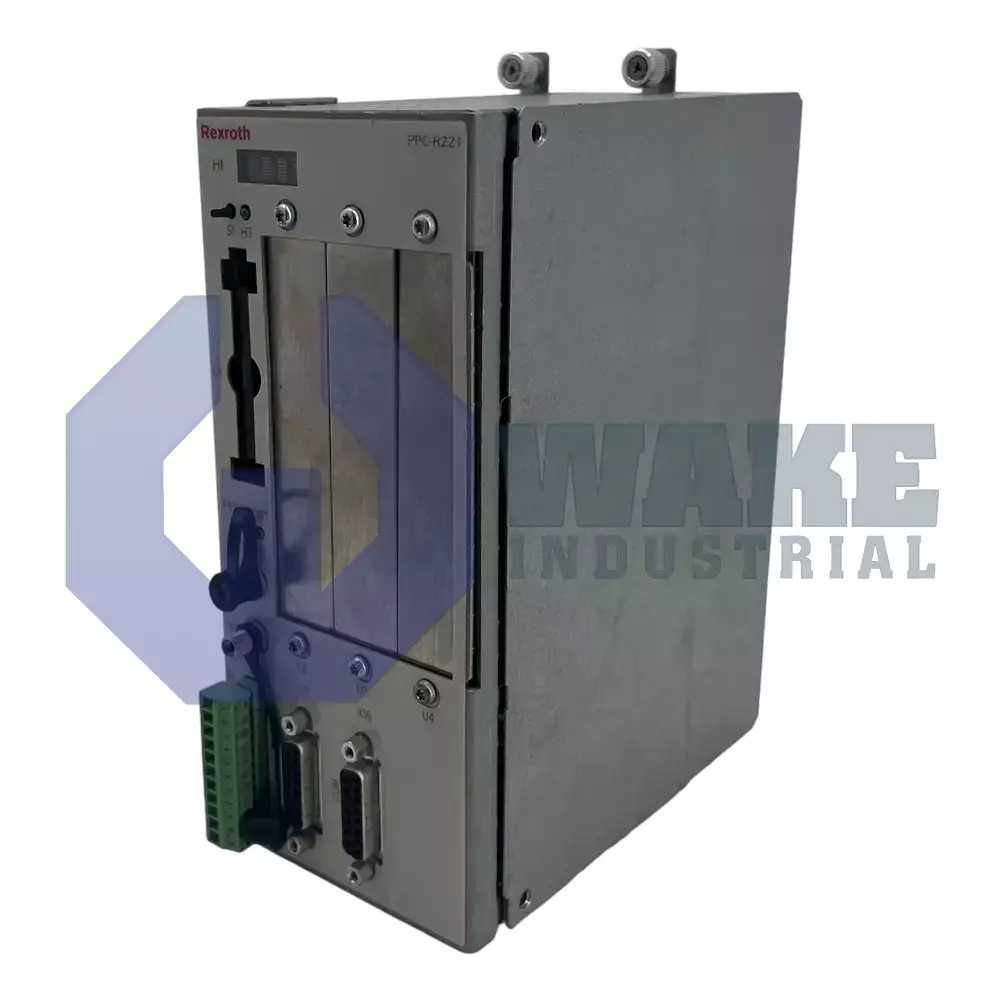
PPC-R22.1N-T-NN-NN-NN-FW Bosch Rexroth Indramat
Wake Industrial LLC is not an authorized distributor of this product.
MPN: 1070170191
No Tariffs On US Orders- Straightforward Pricing: No Rush Fees, No Credit Card Fees
The Bosch Rexroth Indramat PPC-R22.1N-T-NN-NN-NN-FW control unit is part of the PPC Controllers series and has a nominal supply voltage of 24 V DC, with supported voltage ranging from 19.2 to 30 V DC. This unit has a RECO housing design, a maximum controller current of 1.2 A, and an IP20 protection rating. It features a maximum fuse rating of 4 A (slow-blow) and weighs 1.3 kg.


To contact sales for pricing and lead time:
Payment Methods


Shipping Methods


Our Credentials


Product Description:
The Bosch Rexroth Indramat PPC-R22.1N-T-NN-NN-NN-FW belongs to the PPC Controllers series. It is a compact control unit that executes motion sequences, supervises input and output channels, and communicates with drive systems for coordinated positioning and logic tasks in industrial automation. This supports centralized motion-sequence and I/O handling in compatible systems. The electronics are contained in a RECO unit housing that clips onto standard mounting racks and supports front-access wiring, which helps keep cabinet layouts orderly in tightly spaced installations.
Internally, the controller draws up to 1.2 A from the control cabinet's DC rail, so the supply must provide that current to prevent brownouts during peak CPU demand. Design version 1 marks the first hardware revision. An onboard slow-blow fuse rated at 4 A provides time-delay protection for the 24 V supply input. With a protection rating of IP20, the enclosure blocks accidental finger contact yet requires installation inside a closed electrical cabinet. The unit weighs 1.3 kg, so it places only a light load on the mounting structure.
The control unit accepts 19.2 to 30 V DC, with a nominal supply of 24 V DC, and it tolerates up to 5 % ripple. A dedicated backplane distributes up to 2.2 A at 24 V to field terminals, providing a maximum of 52 W for sensors, relays, and light actuators without external feeders. Field devices can therefore be powered directly from the controller when their combined demand stays within the available output. No memory expansion is fitted, so application programs must reside entirely in the onboard flash.









