


PPC-R02.2N-N-N1-T2-NN-FW Bosch Rexroth Indramat
Wake Industrial LLC is not an authorized distributor of this product.
Wake Industrial LLC is not an authorized distributor of this product.
MPN: R911290007
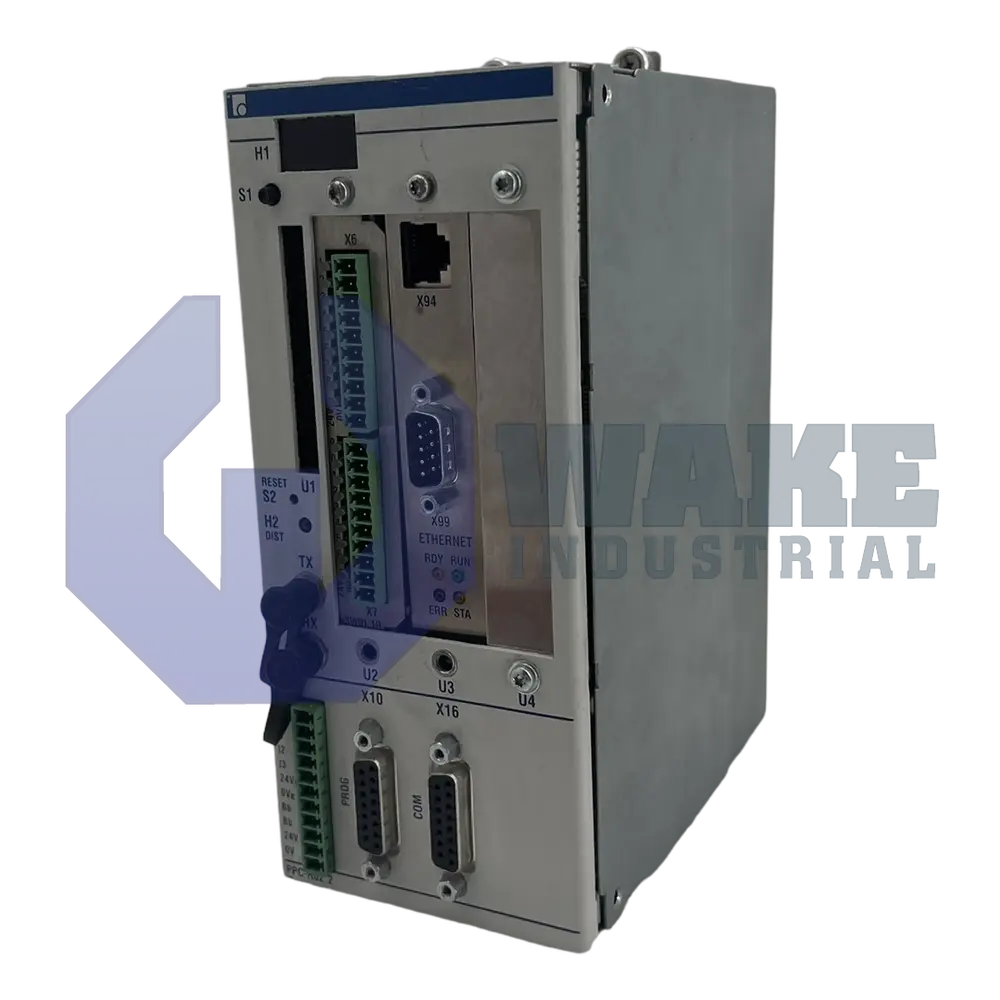
The Bosch Rexroth Indramat PPC-R02.2N-N-N1-T2-NN-FW is a control unit from the PPC Controllers series and features a RECO unit housing design. This version 2 model includes an Ethernet 10 Mb interface and an option card PLS module NSW01, but does not have memory expansion.
Internal Product Review
The PPC-R02.2N-N-N1-T2-NN-FW is a Bosch Rexroth Indramat control unit built in a RECO unit housing. Design version 2 with the NSW01 PLS option card gives the controller a well-structured feature set for coordinated machine functions. The ETH01 10 Mb Ethernet interface supports dependable communications and rounds out a capable PPC controller.
 Have a part to sell?
 Wake Industrial Warranty
To contact sales for pricing and lead time:
Payment Methods


Shipping Methods


Our Credentials


Product Description:
The PPC-R02.2N-N-N1-T2-NN-FW is a programmable motion-logic controller from Bosch Rexroth Indramat and belongs to the PPC Controllers series. Installed in machine tool or packaging cabinets, the module supplies processing power for axis interpolation, sequence control, and fieldbus supervision. By fitting into a RECO rack alongside servo amplifiers, it links the machine operator interface with drive systems, ensuring deterministic command execution and synchronized motion in automated manufacturing lines such as high-speed indexers and pick-and-place stations. This arrangement allows the control layer and the drive layer to exchange commands quickly, which helps coordinated axes follow programmed paths and timing relationships.
The unit is Design Version 2, indicating the second functional revision of the controller platform. Communication with higher-level networks is provided through an Ethernet 10 Mb interface, identified internally as ETH01; this channel supports deterministic TCP/IP exchanges for diagnostic or recipe data transfer. Mechanical integration uses the RECO unit housing, so the board mounts on standardized backplane connectors and receives its supply and bus signals without discrete wiring. In the system hierarchy, the device is classified as a Control Unit, so it executes motion programs, manages axis parameters, and broadcasts setpoints to attached drives. The network port is suited to plant-level data exchange, while the rack connection handles local communication inside the machine.
For application-specific enhancements, the controller accepts the option card PLS module, identified by code NSW01; this daughterboard generates fast position-latch signals used in press or cut-to-length machinery. The base electronics correspond to Series 2, so CPU clock rate and internal bus timing follow the established profile for this generation. Because there is no memory expansion, all user programs must reside in the factory-installed SRAM and flash, which limits available storage for large PLC projects or extensive cam tables. Applications that rely on electronic cam functions or precise registration can use the add-on card without changing the main rack format.









