

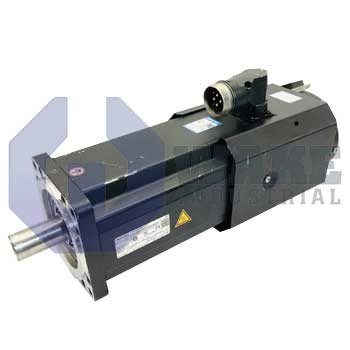
MS2N07-C1BNN-BMUH0-NNNNN-NN Bosch Rexroth Indramat
Wake Industrial LLC is not an authorized distributor of this product.
MPN: R911397454
No Tariffs On US Orders- Straightforward Pricing: No Rush Fees, No Credit Card Fees
The MS2N07-C1BNN-BMUH0-NNNNN-NN synchronous servo motor features a frame size of 07, a rated power up to 2.2 kW, a maximum torque of up to 21 Nm, and IP65 protection. As part of the MS2N Synchronous Servo Motors series by Bosch Rexroth Indramat, it uses natural convection cooling and includes an integrated 18-bit absolute multiturn encoder.


To contact sales for pricing and lead time:
Payment Methods


Shipping Methods


Our Credentials


Product Description:
The MS2N07-C1BNN-BMUH0-NNNNN-NN Synchronous Servo Motor offers exceptional performance for demanding applications. The motor's advanced design ensures reliable operation at maximum speeds of 6000 1/min and maximum torque of 42.2 Nm (warm).
The MS2N07-C1BNN-BMUH0-NNNNN-NN servo motor features a dual cable interface consisting of M23 (power) and M17 (encoder/signal) circular connectors. These connectors are mounted on a rotatable coupling interface that allows up to 270° adjustment to facilitate flexible cable routing and minimize mechanical stress during installation. The servo motor features an encoder with multi turn functionality that provides 4,096 revolutions for accurate position feedback. The electrical connection ensures stable communication while the voltage constant of 114.0 V/1000 min⁻¹ at + 20 °C provides a consistent response. This servo motor boasts a winding inductance of 15.2 mH that offers a balance between high performance and low electrical losses. Its leakage capacitance of 1.85 nF is optimized to minimize interference in sensitive applications. The servo motor has a thermal time constant of 37.8 seconds to ensure consistent operation under varying thermal conditions. The cooling mode of the servo motor is self cooling that makes it suitable for use in various industrial environments. This MS2N series motor weighs 12.0 kg and is compact. The servo motor is integrated with a PT1000 temperature sensor which is a high precision resistance temperature detector (RTD). This sensor operates on the principle of measuring changes in electrical resistance that correspond to temperature variations.
The Bosch Rexroth Indramat MS2N07-C1BNN-BMUH0-NNNNN-NN servo motor supports a maximum current of 29.5 A that offers excellent power handling capabilities. Its flange exactness follows standard specifications and the design is in line with B5 / IM3001 standards for mechanical compatibility.
Frequently Asked Questions about MS2N07-C1BNN-BMUH0-NNNNN-NN:
Q: What are the operational capabilities of the Bosch Rexroth Indramat MS2N07-C1BNN-BMUH0-NNNNN-NN motor?
A: The MS2N07-C1BNN-BMUH0-NNNNN-NN delivers a maximum speed of 6000 1/min and a maximum torque of 42.2 Nm. These features enable reliable performance in demanding applications, offering high efficiency at various operating conditions.
Q: How does the Bosch Rexroth MS2N07-C1BNN-BMUH0-NNNNN-NN motor handle temperature variations?
A: This servo motor has a thermal time constant of 37.8 seconds, ensuring stable performance under fluctuating thermal conditions. Its self-cooling mechanism helps maintain operational reliability across diverse industrial environments.
Q: How does the encoder on the Bosch Rexroth Indramat MS2N07-C1BNN-BMUH0-NNNNN-NN improve accuracy?
A: The motor features an encoder with multi-turn functionality, offering up to 4,096 revolutions for precise position feedback. This ensures accurate and reliable control in advanced motion applications, enhancing system performance.
Q: Can the MS2N07-C1BNN-BMUH0-NNNNN-NN motor be easily integrated into industrial systems?
A: Yes, the motor is equipped with a rotatable double cable connection (M23/M17) for flexible and easy installation. Its design ensures stable electrical communication for seamless integration into a wide range of industrial applications.
Q: How does the PT1000 temperature sensor in the MS2N07-C1BNN-BMUH0-NNNNN-NN motor benefit performance?
A: The PT1000 temperature sensor provides precise temperature measurements by detecting changes in electrical resistance. This allows the motor to maintain optimal performance, preventing overheating and ensuring operational consistency in demanding environments.









