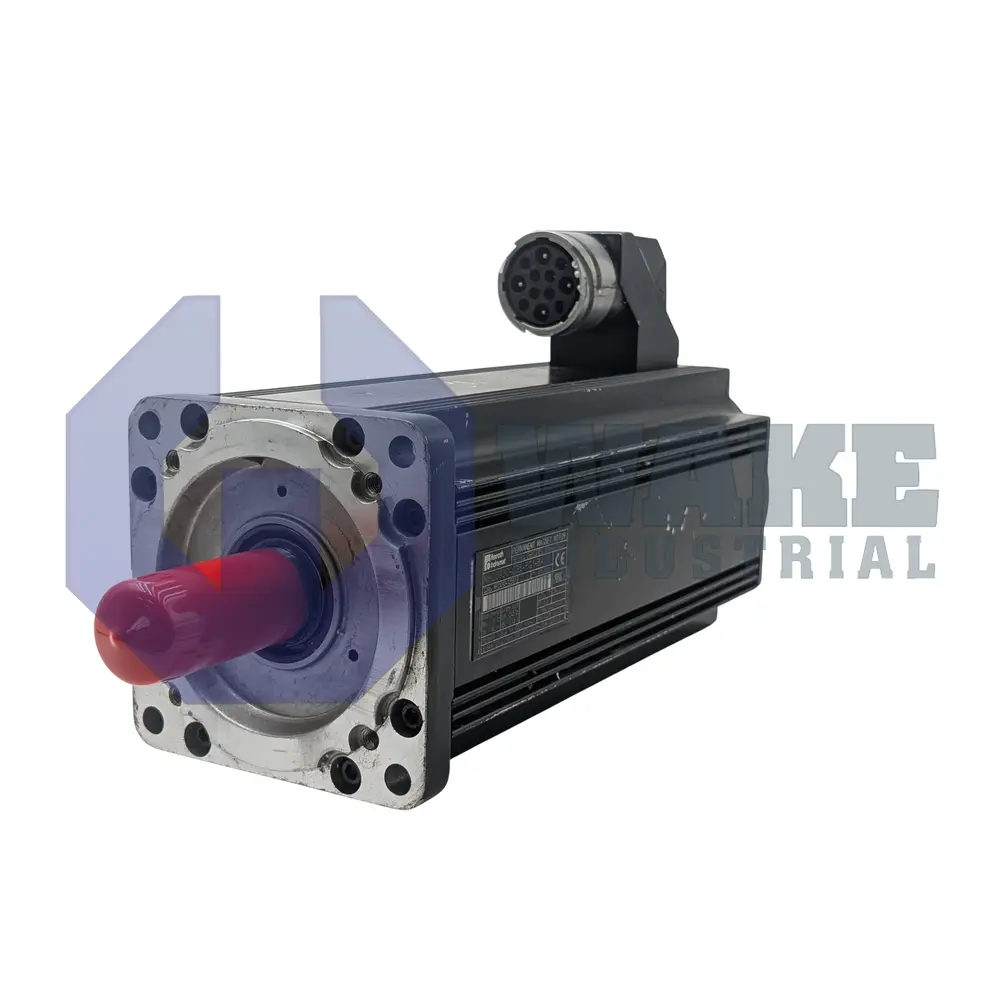
MHD093C-035-NG0-BN

MPN: R911273949

No Tariffs On US Orders
  • Straightforward Pricing: No Rush Fees, No Credit Card Fees
    In-Stock, Ships Today

Preparing your secure checkout page...

The Rexroth Indramat MHD093C-035-NG0-BN servo motor provides continuous torque up to 34.5 Nm and operates efficiently with natural or surface cooling. It has 4 pole pairs that enable dynamic performance.

Quote Request Form:

Warranty
Wake Industrial Warranty
To contact sales for pricing and lead time:

Payment Methods

Visa
Mastercard
AmEx
Wire Transfer

Shipping Methods

DHL
UPS
FedEx
Freight

Our Credentials

Cary Chamber
DUNS Registered
SAM Registered
BBB Accredited

Product Description:

The model MHD093C-035-NG0-BN is a synchronous servo motor designed for demanding industrial applications. This model is manufactured by Rexroth Indramat. It offers precise control, high torque and reliable performance. This motor is ideal for industrial automation systems requiring consistent accuracy and efficiency.

The MHD093C-035-NG0-BN synchronous motor has a characteristic speed of 3000 RPM and is available with different cooling configurations for natural and surface cooling. The continuous torque ranges from 23.0 Nm to 34.5 Nm depending on the cooling method. At a standstill, the continuous current varies between 18.5 A and 27.8 A. The peak current for the motor is 83.5 A providing enough power for short bursts of high demand. Other key electric parameters include a torque constant of 1.39 Nm/A and a voltage constant of 126.4 V/1000rpm. The motor is designed with 4 pole pairs that make it suitable for dynamic performance in automation systems. The model without a holding brake. If a holding brake is required, choose other models that are equipped with holding brakes.

The MAD series synchronous motor operates with rated speeds up to 2500 RPM and a torque range between 9.1 Nm and 26.2 Nm. The rated current spans from 5.2 A to 14.9 A delivering rated power between 2.9 kW and 8.5 kW depending on the configuration. The motor operates with a voltage of 322 V to 342 V and a frequency of 167 Hz. Its robust mechanical design features a moment of inertia of 30.0 x 10^-4 kgm^2 and a maximum torque of 88 Nm. The Indramat motor includes an IP65 protection rating which ensures durability in industrial environments and insulation class F according to DIN standards.

Characteristic Speed
3000 rpm
Insulation Class
F
Mass
23.5 kg
Maximum Elevation Height
1000 meters above sea
Maximum Speed
4500 rpm
Moment of Inertia of the Rotor
30 x 10-4 kgm2
Motor Encoder
Digital Servo Feedback
Operating Temperature Range
0 to + 40 centigrade
Peak Current
83.5 A
Protection Rating
IP65
Shaft
Plain Shaft
Theoretical Maximum Torque
88 Nm
Torque Constant
1.39 Nm/A
Winding Inductivity
6.2 mH
Winding Resistance
0.79 ohms
  • MHD093C035NG0BN
  • MHD093C 035 NG0 BN
  • mhd093c-035-ng0-bn
  • MHD93C-035-NG0-BN
Instructions

Use this calculator to compute the acceleration torque required to accelerate a load in a servomotor system. Enter the total inertia and angular acceleration, then click "Calculate Acceleration Torque" to see the result.

The acceleration torque is calculated using the formula: T_acc = J_total * α, where:

  • T_acc is the acceleration torque (Nm)
  • J_total is the total inertia of the system (kg·m²)
  • α (alpha) is the angular acceleration (rad/s²)

The total inertia (J_total) should include both the motor inertia and the load inertia reflected to the motor shaft.

Understanding Acceleration Torque

Acceleration torque is essential in defining the capability of a servomotor to initiate rotational motion. It's the torque required to overcome inertia and achieve a desired angular acceleration. In servomotor systems, proper torque calculation ensures optimal performance, preventing motor strain and energy inefficiency.

Importance for Industrial Automation

In industrial automation, precise motion control is vital. Calculating acceleration torque enables designers to choose suitable motors that meet dynamic motion demands, essential for the smooth operation of automated systems. This consideration enhances efficiency and prolongs motor lifespan in applications such as robotic arms and precision manufacturing equipment.

Instructions

Use this calculator to compute the acceleration torque required to accelerate a load in a servomotor system. Enter the total inertia and angular acceleration, then click "Calculate Acceleration Torque" to see the result.

The acceleration torque is calculated using the formula: T_acc = J_total * α, where:

  • T_acc is the acceleration torque (Nm)
  • J_total is the total inertia of the system (kg·m²)
  • α (alpha) is the angular acceleration (rad/s²)

The total inertia (J_total) should include both the motor inertia and the load inertia reflected to the motor shaft.

Understanding Acceleration Torque

Acceleration torque is essential in defining the capability of a servomotor to initiate rotational motion. It's the torque required to overcome inertia and achieve a desired angular acceleration. In servomotor systems, proper torque calculation ensures optimal performance, preventing motor strain and energy inefficiency.

Importance for Industrial Automation

In industrial automation, precise motion control is vital. Calculating acceleration torque enables designers to choose suitable motors that meet dynamic motion demands, essential for the smooth operation of automated systems. This consideration enhances efficiency and prolongs motor lifespan in applications such as robotic arms and precision manufacturing equipment.

Instructions

Use this calculator to compute the control output for a PID controller in a servomotor system. Enter the PID gains (Kp, Ki, Kd), the current error, and the time step, then click "Calculate Control Output" to see the result.

The calculation uses the PID control law: u(t) = Kp * e(t) + Ki * ∫e(t)dt + Kd * de(t)/dt, where:

  • u(t) is the control output (e.g., motor voltage)
  • e(t) is the error (desired position - actual position)
  • Kp is the proportional gain
  • Ki is the integral gain
  • Kd is the derivative gain

Note: This calculator provides a simplified single-step calculation. In a real system, the PID controller would run continuously, updating the control output at each time step.

Understanding PID Controllers

PID controllers are essential in control systems, offering a way to regulate processes through feedback loops. They adjust control inputs based on the error between desired and actual outputs. The proportional term addresses present errors, the integral term corrects accumulated past errors, and the derivative term predicts future errors, enabling precise control.

Importance in Servo Systems

In servomotor applications, PID controllers ensure precise movement and positioning, which is crucial for industrial automation. By continuously adjusting the control signal (e.g., motor voltage), they maintain the desired position despite external disturbances or changes in system dynamics.

Instructions

Use this calculator to compute the control output for a PID controller in a servomotor system. Enter the PID gains (Kp, Ki, Kd), the current error, and the time step, then click "Calculate Control Output" to see the result.

The calculation uses the PID control law: u(t) = Kp * e(t) + Ki * ∫e(t)dt + Kd * de(t)/dt, where:

  • u(t) is the control output (e.g., motor voltage)
  • e(t) is the error (desired position - actual position)
  • Kp is the proportional gain
  • Ki is the integral gain
  • Kd is the derivative gain

Note: This calculator provides a simplified single-step calculation. In a real system, the PID controller would run continuously, updating the control output at each time step.

Understanding PID Controllers

PID controllers are essential in control systems, offering a way to regulate processes through feedback loops. They adjust control inputs based on the error between desired and actual outputs. The proportional term addresses present errors, the integral term corrects accumulated past errors, and the derivative term predicts future errors, enabling precise control.

Importance in Servo Systems

In servomotor applications, PID controllers ensure precise movement and positioning, which is crucial for industrial automation. By continuously adjusting the control signal (e.g., motor voltage), they maintain the desired position despite external disturbances or changes in system dynamics.

Instructions

Use this calculator to convert between different units of power. Select the units you want to convert from and to, enter the value, and click "Convert" to see the result.

Understanding Power Units

Power is a foundational concept in both everyday life and industrial applications. The term "watts" is ubiquitous, named after James Watt, a pivotal figure in the industrial revolution known for his advancements in steam engine technology. A watt represents the rate at which energy is transferred or converted and forms the basis for other power units such as kilowatts (1,000 watts), megawatts (1,000,000 watts), and more.

Importance in Industrial Automation and Servomotors

In industrial automation, precise power control is critical for maximizing efficiency and accuracy. Servomotors, essential components in automation systems, rely heavily on accurate power measurement. These motors, often used in robotics and CNC machinery, require specific power inputs to function correctly, translating electrical energy into controlled movements. The ability to convert between different power units helps engineers and technicians optimize these systems for energy consumption and performance. Whether ensuring that a robotic arm operates with sufficient power or managing the electrical requirements of a complex assembly line, understanding and converting power units is a crucial skill.

As technology advances, the necessity for precision grows. Power conversion tools, therefore, play an indispensable role in maintaining system efficiency and reliability, making them a staple in the toolkit of modern engineers and industrial technicians.

Instructions

Use this calculator to convert between different units of power. Select the units you want to convert from and to, enter the value, and click "Convert" to see the result.

Understanding Power Units

Power is a foundational concept in both everyday life and industrial applications. The term "watts" is ubiquitous, named after James Watt, a pivotal figure in the industrial revolution known for his advancements in steam engine technology. A watt represents the rate at which energy is transferred or converted and forms the basis for other power units such as kilowatts (1,000 watts), megawatts (1,000,000 watts), and more.

Importance in Industrial Automation and Servomotors

In industrial automation, precise power control is critical for maximizing efficiency and accuracy. Servomotors, essential components in automation systems, rely heavily on accurate power measurement. These motors, often used in robotics and CNC machinery, require specific power inputs to function correctly, translating electrical energy into controlled movements. The ability to convert between different power units helps engineers and technicians optimize these systems for energy consumption and performance. Whether ensuring that a robotic arm operates with sufficient power or managing the electrical requirements of a complex assembly line, understanding and converting power units is a crucial skill.

As technology advances, the necessity for precision grows. Power conversion tools, therefore, play an indispensable role in maintaining system efficiency and reliability, making them a staple in the toolkit of modern engineers and industrial technicians.

Frequently Asked Questions about MHD093C-035-NG0-BN:

Q: What is the speed and cooling configuration of the MHD093C-035-NG0-BN motor?

A: The MHD093C-035-NG0-BN operates at a characteristic speed of 3000 RPM. It supports natural and surface cooling, allowing for continuous torque between 23.0 Nm and 34.5 Nm based on the cooling method.

Q: What is the peak current and continuous current of the MHD093C-035-NG0-BN motor?

A: The motor has a peak current of 83.5 A, providing sufficient power for high-demand applications. The continuous current ranges from 18.5 A to 27.8 A depending on the load conditions.

Q: Does the MHD093C-035-NG0-BN motor include a holding brake?

A: No, this model does not include a holding brake. If a holding brake is needed, users should select a different version equipped with that feature.

Q: What environmental protection does the MHD093C-035-NG0-BN motor offer?

A: The motor is rated with an IP65 protection level. This ensures durability in industrial environments and protection from dust and water ingress, making it suitable for harsh conditions.

Q: What are the torque and voltage constants for the MHD093C-035-NG0-BN motor?

A: The torque constant is 1.39 Nm/A, ensuring precise performance. Its voltage constant is 126.4 V/1000rpm, supporting efficient operation in industrial automation systems.


Internal Product Review

  • ‘‘The MHD093C-035-NG0-BN synchronous motor from Rexroth Indramat stands out with its 83.5 A peak current, 3000 RPM speed, and torque range of up to 34.5 Nm. It has a plain shaft and a protection rating of IP65. Its robust design makes it the optimal choice for industrial automation systems.’’

Motion Industries logo
3M logo
IBM logo
Gexpro Logo
Caterpillar logo
NASA logo
Ford logo
Vallen logo