


MHD093B-035 Bosch Rexroth Indramat
Wake Industrial LLC is not an authorized distributor of this product.
- Straightforward Pricing: No Rush Fees, No Credit Card Fees
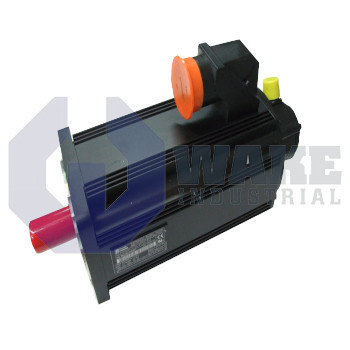
The Bosch Rexroth Indramat MHD093B-035 is a servo motor from the MHD Synchronous Motors series, featuring a centering diameter of 130 mm and a flange size of either 140 mm or 150 mm. The motor delivers a continuous torque at standstill of 17.5 Nm and has a motor size of 093 with the B motor length.


To contact sales for pricing and lead time:
Payment Methods


Shipping Methods


Our Credentials


Product Description:
The MHD093B-035 is a brushless servo motor produced by Bosch Rexroth Indramat for the MHD Synchronous Motors series. It serves as a rotary actuator in CNC cells, material-handling gantries, and other closed-loop axes that require repeatable speed and position control. This type of motor is typically paired with a compatible servo drive so commanded current becomes controlled torque, smooth acceleration, and steady low-speed operation under changing loads. The motor is suited for couplings, gear sets, or belt-driven mechanisms mounted directly on the machine frame.
The motor delivers a continuous torque of 17.5 Nm at standstill, giving the drive enough margin to hold or jog a loaded axis without overheating. A centering pilot of 130 mm aligns the housing with the machine flange and helps keep radial runout within required limits. Mounting holes on a dual-pattern 140 / 150 mm square flange let the unit fit both ISO and proprietary frames used in industrial equipment. Electrical behavior is set by winding code 035, which uses resistance, inductance, and back-EMF values suited to mid-range inverter outputs. These characteristics make the motor suitable for axes that need controlled holding torque as well as stable motion during indexing and positioning cycles.
Mechanical length class B uses a lamination stack height that affects inertia and thermal mass in the 093 frame. A permanent-magnet rotor supports fast torque response, while the digital feedback interface gives the drive the position data needed for accurate closed-loop control. The motor also uses a thermally optimized stator to move heat away from the windings during repeated motion cycles. That combination supports repeated starts, stops, and direction changes without the instability associated with open-loop motion systems.









