


KSM02.1B-071C-24N-M1-HG0-ET-S3-D7-NN-FW Bosch Rexroth Indramat
Wake Industrial LLC is not an authorized distributor of this product.
MPN: R911371525
No Tariffs On US Orders- Straightforward Pricing: No Rush Fees, No Credit Card Fees
Current response time:
3 Minutes
27 Seconds
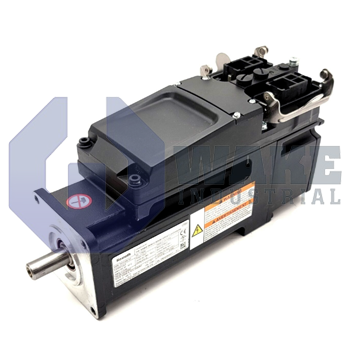
The Bosch Rexroth Indramat KSM02.1B-071C-24N-M1-HG0-ET-S3-D7-NN-FW is a motor-integrated servo drive from the KSM Motor Integrated Servo Drives series. It features a hybrid connector, Multi-Ethernet protocol, and operates on a supply voltage of DC 750 V. The drive uses natural convection cooling and has an optical multi-turn absolute encoder with a Hiperface interface.


To contact sales for pricing and lead time:
Payment Methods


Shipping Methods


Our Credentials


Product Description:
The KSM02.1B-071C-24N-M1-HG0-ET-S3-D7-NN-FW is a motor-integrated servo drive from Bosch Rexroth Indramat in the KSM Motor Integrated Servo Drives series. By combining drive electronics, encoder, and power interfaces in one enclosure, it shortens wiring runs and frees cabinet space on distributed machine axes. In packaging, handling, or transfer systems, the unit takes a DC bus supply and regulates torque and speed while sending precise position feedback to the motion controller. Because the inverter and feedback hardware are built into the motor housing, the machine layout can be more compact than a cabinet-centered axis design.
It runs from a DC 750 V bus, so no intermediate AC rectifier is needed. All feedback, power, and network conductors share a single hybrid connector, simplifying cable routing. Heat leaves the housing by natural convection, removing fans and preserving enclosure integrity. Multi-axis controllers link over Multi-Ethernet, and protocol selection such as EtherNet/IP, EtherCAT, PROFINET, or Sercos is done in software. The motor uses winding code 24, matched to frame size 071 and length C for the unit's torque range. The drive uses the standard mechanical option and design version 1, and it includes a shaft seal for bearing protection. Safe Motion supervision is available without an SBC module, and the unit is delivered without a holding brake.
The optical encoder uses the Hiperface interface and delivers 128 signal periods per turn. Its multi-turn absolute memory retains position through power loss, eliminating reference moves after restart. A plain shaft mates with couplings or pulleys, and the shaft seal helps retain grease. Stationary loads must be held by external mechanics or commanded torque. Optical scanning supports stable low-speed servo control, and the basic performance level suits general-purpose automation tasks that use distributed drive hardware.









