


KDA 3.2-150-3-L0I-W1 Bosch Rexroth Indramat
Wake Industrial LLC is not an authorized distributor of this product.
- Straightforward Pricing: No Rush Fees, No Credit Card Fees
Current response time:
6 Minutes
49 Seconds
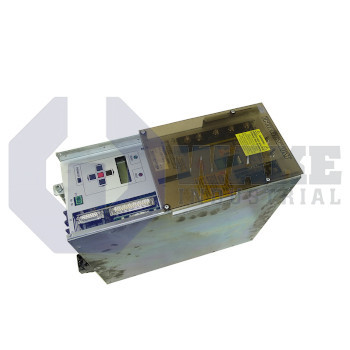
The Bosch Rexroth Indramat KDA 3.2-150-3-L0I-W1 is a spindle drive from the KDA Spindle Drives series and operates with a rated current of 150 Amps. It supports a DC supply voltage of 300 VDC and uses forced cooling through a mounted heatsink blower. The drive features an incremental encoder output and receives speed command values via a SERCOS interface.


To contact sales for pricing and lead time:
Payment Methods


Shipping Methods


Our Credentials


Product Description:
The KDA 3.2-150-3-L0I-W1 is a spindle drive from Bosch Rexroth Indramat that belongs to the KDA Spindle Drives series. The unit sits between the CNC controller and the motor, converting the DC link supply into controlled three-phase power for high-speed spindles used in metal-cutting and machining centers. Within an automation cell, it regulates rotational speed, provides torque control, and transmits feedback to higher-level motion systems. In machine tools, that role allows commanded spindle speed to track program changes during drilling, milling, and tapping operations without relying on a separate inverter stage.
The drive is energized from a DC bus of 300 VDC, and its power electronics are rated for a continuous output of 150 A, so the connected spindle motor can accelerate quickly under load and hold speed during cutting. Speed commands arrive through the SERCOS interface, allowing deterministic setpoint updates that align with controller cycles and support synchronized motion with feed axes. Internal losses are removed by forced-air cooling, implemented through a dedicated heat sink section whose blower operates from 220 V/50–60 Hz. This cooling method helps the power section remain stable during repeated acceleration and deceleration of the spindle.
The drive operates at ambient temperatures from 5 °C to 45 °C and at installation altitudes up to 1000 m without derating. Position feedback can be routed to external diagnostics through the incremental encoder output, while the primary control loop relies on the first encoder channel for closed-loop regulation. The unit does not have a second encoder input, which reduces redundant wiring and keeps the feedback layout straightforward. Heat extraction relies on a housing-mounted heat sink blower, so cabinet airflow is not required around the main housing.









