


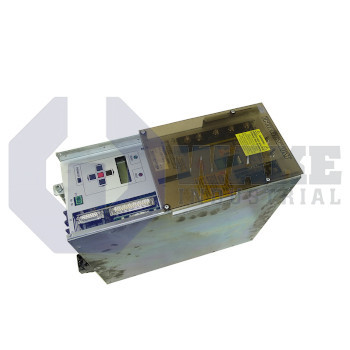
KDA 3.2-150-3-DPS-W1 Bosch Rexroth Indramat
Wake Industrial LLC is not an authorized distributor of this product.
- Straightforward Pricing: No Rush Fees, No Credit Card Fees
Current response time:
3 Minutes
30 Seconds
The Bosch Rexroth Indramat KDA 3.2-150-3-DPS-W1 is a spindle drive from the KDA Spindle Drives series, featuring a rated current of 150 Amps and a DC supply voltage of 300 Volts. It uses a mounted heatsink blower for forced cooling and supports serial interface RS 232 C communication. The unit offers a second encoder input for spindle feedback or additional motor feedback, and is designed to operate in ambient temperatures from 5 to 45 degrees Celsius.


To contact sales for pricing and lead time:
Payment Methods


Shipping Methods


Our Credentials


Product Description:
The KDA 3.2-150-3-DPS-W1 spindle drive is produced by Bosch Rexroth Indramat for the KDA Spindle Drives series. It converts a stabilized DC link into controlled three-phase output so that machine-tool spindles can maintain programmed speed and torque during cutting, drilling, or grinding. This arrangement helps the spindle react to changing cutting loads without losing speed stability during a machining cycle. Because spindle behavior directly affects surface finish and tool life, stable torque delivery is important when the machine transitions between roughing and finishing passes. The unit is series 3, version 2, placing it in a product generation intended for mid-power CNC spindle applications.
The DC bus feeds the power stage with 300 VDC, and the drive can deliver a continuous motor phase current of 150 A. Thermal energy from the power electronics is removed by a mounted heatsink blower supplied with 220 V, 50–60 Hz. This blower provides forced cooling, so internal temperatures remain within the permitted operating range even in a sealed cabinet. Safe operation is specified between 5 to 45 °C, and the airflow helps prevent early current derating during long machining runs. The separate blower supply keeps the cooling function independent of spindle output demand, which supports steady thermal control during varying load conditions.
Site limits extend to 1000 m above sea level, because thinner air above that elevation reduces cooling effectiveness. Speed commands arrive through a 16-bit digital parallel bus, which gives the controller fine resolution for velocity setpoints during spindle control. Diagnostic and parameter access use a RS-232-C serial interface, while a second encoder input supports additional feedback for orientation or synchronized spindle functions. That arrangement is useful on machines that need spindle orientation before tool changes or synchronized motion during rigid tapping. This combination allows the drive to support closed-loop spindle regulation, status access, and feedback processing without unnecessary interface complexity.









