


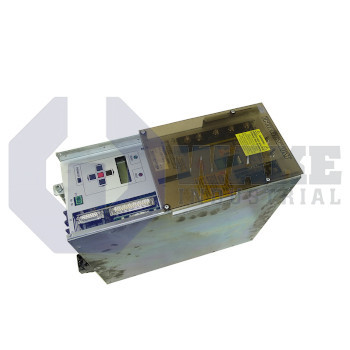
KDA 3.2-150-3-AYS-W1 Bosch Rexroth Indramat
Wake Industrial LLC is not an authorized distributor of this product.
Wake Industrial LLC is not an authorized distributor of this product.
The Bosch Rexroth Indramat KDA 3.2-150-3-AYS-W1 is a spindle drive from the KDA Spindle Drives series with a rated current of 150 Amps and a DC supply voltage of 300 VDC. It features forced cooling via a mounted heatsink blower and operates within an ambient temperature range of 5 to 45 degrees Celsius. The drive includes a serial interface RS 232 C and has a second encoder input and synchronous input.
Internal Product Review
The KDA 3.2-150-3-AYS-W1 spindle drive from Bosch Rexroth Indramat delivers high performance with a rated current of 150 A and operates efficiently on a 300 VDC supply. Forced cooling via a mounted heatsink blower ensures stable operation across a 5 to 45 degrees Celsius ambient temperature range. The inclusion of a serial interface (RS 232 C) along with a second encoder input makes it an adaptable solution for advanced spindle control applications.
 Have a part to sell?
 Wake Industrial Warranty
To contact sales for pricing and lead time:
Payment Methods


Shipping Methods


Our Credentials


Product Description:
The KDA 3.2-150-3-AYS-W1 is a spindle drive developed by Bosch Rexroth Indramat for the KDA Spindle Drives series. Within the series coding, the 3 identifies the product generation and the 2 indicates the version level. As a spindle drive, it converts DC bus energy from an Indramat supply module into three-phase power for regulating the speed and torque of high-speed machining spindles in automated production cells. It is suited for machine tools that require stable spindle behavior, responsive torque control, and repeatable performance during cutting cycles.
This version uses a mounted heatsink blower that operates on 220 V 50–60 Hz, and it uses forced cooling for continuous thermal management during full-load duty. Its DC bus link requires 300 VDC, and the power section can deliver a continuous output of 150 A to the connected spindle motor. Safe operation is permitted at ambient temperatures from 5 to 45 °C, allowing installation in most enclosed factory cabinets. The electrical speed reference enters the control board as an analog voltage, while the blower helps keep the power electronics within their intended temperature range during sustained spindle operation.
The permissible site altitude reaches 1000 m above sea level without derating, supporting installation in elevated facilities as well as standard plant areas. Parameter adjustments and diagnostic data exchange are handled through an RS-232-C serial interface, and process feedback can be refined through a second encoder input that also carries a synchronous track for rigid tapping or spindle orientation routines. The velocity reference arrives as an analog speed command, matching legacy motion controllers that use voltage-based setpoints. These communication and feedback functions support accurate spindle response during synchronized machine movements.