


KDA 3.2-150-3-A00-W0 Bosch Rexroth Indramat
Wake Industrial LLC is not an authorized distributor of this product.
Wake Industrial LLC is not an authorized distributor of this product.
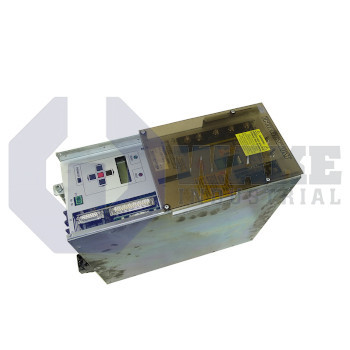
The Bosch Rexroth Indramat KDA 3.2-150-3-A00-W0 is part of the KDA Spindle Drives series and is a spindle drive with a rated current of 150 Amps. It uses forced cooling and operates with a DC supply voltage of 300 VDC and an AC source for the heatsink blower at 220V 50-60Hz. The drive works in ambient temperatures from 5 to 45 degrees Celsius and is designed for installations up to 1000 meters above sea level.
Internal Product Review
The KDA 3.2-150-3-A00-W0 spindle drive from Bosch Rexroth Indramat delivers high performance with a rated current of 150 A and a DC supply voltage of 300 VDC, making it suitable for demanding spindle applications. Forced cooling ensures stable operation within the 5 to 45 degrees Celsius ambient temperature range. This drive stands out for reliable performance and straightforward analog speed command integration.
 Have a part to sell?
 Wake Industrial Warranty
To contact sales for pricing and lead time:
Payment Methods


Shipping Methods


Our Credentials


Product Description:
The Bosch Rexroth Indramat KDA 3.2-150-3-A00-W0 is a spindle drive in the KDA Spindle Drives series. It converts direct-current bus power into controlled three-phase output for machine-tool spindles, allowing precise speed and torque regulation under digital or CNC supervision during cutting, drilling, and grinding processes where spindle load can change quickly. This lets the motor maintain commanded speed during material engagement, tool entry, and finish passes that demand repeatable spindle behavior. It is in series 3 and version 2, and its role in industrial automation is to keep spindle motion stable while the controller commands acceleration, constant-speed running, and deceleration across different machining cycles.
The drive draws its DC link energy from the bus and can deliver a continuous output of 150 A, enabling high shaft power when matched to large-frame spindle motors and supporting sustained operation under heavy machining loads. Internal semiconductors are kept within thermal limits by forced cooling; a heat sink blower powered from a separate 220 V/50-60 Hz source moves air across the fins independently of cabinet airflow. Logic boards receive speed references as an analog voltage, which is processed by the control card to modulate pulse patterns sent to the output bridge so the commanded spindle speed can be followed accurately. The intermediate circuit is maintained at 300 VDC, so the upstream power supply must provide that level and absorb regenerated energy during spindle deceleration or rapid speed changes.
The unit can run in ambient temperatures from 5 to 45 degrees Celsius without current derating, and installation heights are limited to 1000 m above sea level so that cooling airflow and dielectric clearances remain effective during normal machine operation. Additional communication hardware is unavailable because the configuration uses no additional interface option, which leaves the drive with its standard control connection set and prevents add-on interface expansion within this version. A second-encoder channel is unavailable because the unit has no additional encoder input, so feedback is handled through the primary path only for spindle regulation and speed monitoring.









