


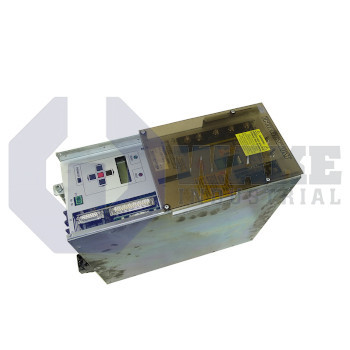
KDA 3.2-100-3-A0D-W1 Bosch Rexroth Indramat
Wake Industrial LLC is not an authorized distributor of this product.
- Straightforward Pricing: No Rush Fees, No Credit Card Fees
Current response time:
4 Minutes
53 Seconds
The Bosch Rexroth Indramat KDA 3.2-100-3-A0D-W1 is a spindle drive from the KDA Spindle Drives series. It operates with a rated current of 100 Amps and a DC supply voltage of 300 VDC, and uses a mounted heatsink blower for forced cooling. The drive supports both position command value via digital interface and speed command value via analogue input.


To contact sales for pricing and lead time:
Payment Methods


Shipping Methods


Our Credentials


Product Description:
The KDA 3.2-100-3-A0D-W1 is a spindle-drive controller manufactured by Bosch Rexroth Indramat for the KDA Spindle Drives series. Inside the product code, the digit 3 denotes the internal design family, and the following 2 indicates the version status. By converting DC-bus energy into controlled three-phase output, the drive governs the acceleration, constant-speed cutting, and deceleration phases of machine-tool spindles used in automated milling, turning, and grinding cells. This operating role makes it suitable for spindle applications that require stable speed regulation during changing cutting conditions and repeated production cycles.
The power stage is supplied from a DC link of 300 VDC, and it can deliver a continuous output of 100 A to the motor windings, allowing substantial torque during roughing passes. An auxiliary blower that runs from a separate 220 V 50/60 Hz source cools the heat-generating components, and the unit uses a mounted heat sink blower attached to the cabinet rear panel. The velocity loop accepts an analog speed command value, so the numerical control can issue proportional spindle-speed references without digital serialization. A built-in converter also forwards tachometer feedback, and because the unit lacks a second encoder input, only one position-transducer channel is required.
Environmental limits begin with an operating range of 5 to 45 °C, providing temperature headroom for factory workshops. Installation is permitted up to 1000 m above sea level before derating applies, which matches standard plant elevations. For coarse positioning tasks, the controller accepts a digital position command value interface that shares the same port area as the speed reference. Thermal management relies on forced cooling, and the constant airflow helps prevent semiconductor hot spots during prolonged high-load cycles. The drive’s control cards sit behind a screened front cover, and all logic wiring is routed through shielded plugs so electromagnetic disturbance remains within CNC system tolerances.