


KDA 3.1-150-3-AQS-W1 Bosch Rexroth Indramat
Wake Industrial LLC is not an authorized distributor of this product.
Wake Industrial LLC is not an authorized distributor of this product.
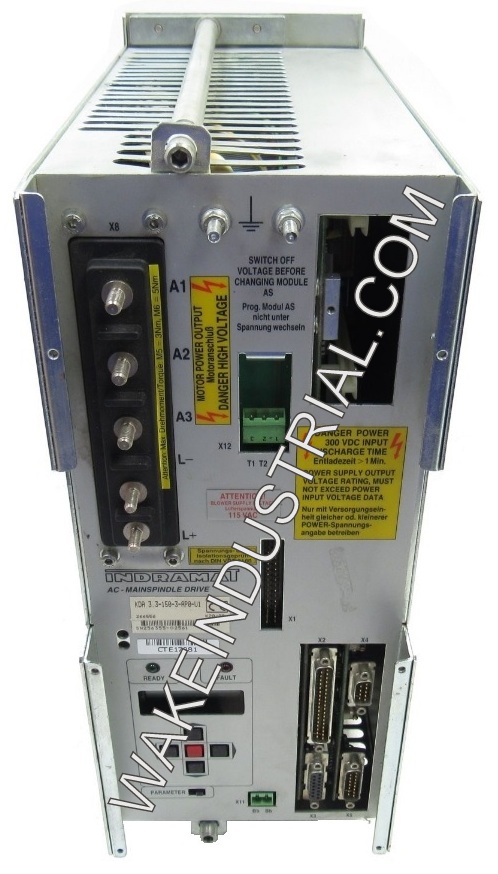
The Bosch Rexroth Indramat KDA 3.1-150-3-AQS-W1 is a spindle drive from the KDA Spindle Drives series. It features a rated current of 150 Amps and uses a mounted heatsink blower with forced cooling. This unit operates with a 300 VDC supply voltage and includes a serial RS 232 C interface.
Internal Product Review
The KDA 3.1-150-3-AQS-W1 spindle drive from Bosch Rexroth Indramat features a 150 A rated current and a reliable forced cooling system with a mounted heatsink blower for consistent thermal management. With support for a 300 VDC supply voltage and a serial RS 232 C interface, this unit is well-suited for demanding spindle applications. Overall, the combination of high current handling and efficient cooling makes this spindle drive a strong choice for industrial settings.
 Have a part to sell?
 Wake Industrial Warranty
To contact sales for pricing and lead time:
Payment Methods


Shipping Methods


Our Credentials


Product Description:
The KDA 3.1-150-3-AQS-W1 belongs to the KDA Spindle Drives series produced by Bosch Rexroth Indramat. Within machining centers and grinding stations, the unit converts regulated DC-bus power into three-phase output for high-speed spindle motors, allowing precise speed profiles that match material removal requirements. By regulating output frequency and current, the drive supports rapid spindle response during tool changes, ramp-up, and constant-speed cutting. Its third-generation design includes a dedicated heatsink blower and modular control boards, which helps reduce interruptions on automated production lines.
The drive's power section operates from a DC link of 300 VDC, establishing the internal bus potential that the inverter stage modulates. Its continuous output capability reaches 150 A, permitting large acceleration currents without thermal trip when paired with compatible spindles. A separate blower circuit rated at 220 V, 50/60 Hz powers the heatsink fan, isolating cooling power from the main bus and helping keep semiconductor temperatures stable during extended duty cycles. Speed references are accepted as an analog voltage, which simplifies integration with legacy CNC controllers that issue ±10 V commands. This arrangement suits retrofit systems that still depend on analog command channels. A serial interface (RS-232-C) is provided on the front panel for parameter uploads and diagnostics.
The thermal design centers on a mounted heatsink blower that pulls air directly across the IGBT stack, and this active element works with forced cooling to dissipate switching losses during high-current operation. Safe operation is specified between 5 to 45 °C, so enclosure climate control must prevent ambient conditions from exceeding that range. Directed airflow across the power section helps the inverter sustain demanding spindle cycles without relying on passive heat dissipation alone. Installation is allowed up to 1000 m above sea level, because thinner air at higher elevations reduces cooling effectiveness and can limit heat removal.









