


KDA 3.1-150-3-AQ0-U1 Bosch Rexroth Indramat
Wake Industrial LLC is not an authorized distributor of this product.
Wake Industrial LLC is not an authorized distributor of this product.
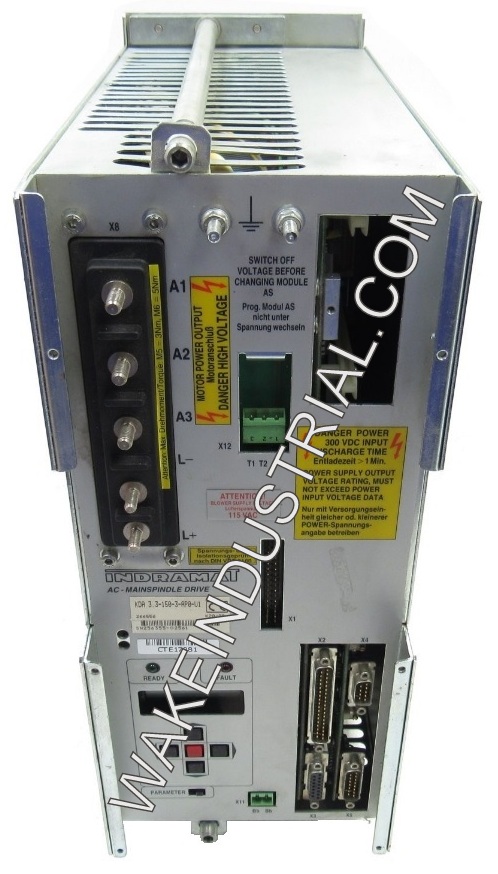
The Bosch Rexroth Indramat KDA 3.1-150-3-AQ0-U1 is part of the KDA Spindle Drives series and features a rated current of 150 Amps. It uses forced cooling with a mounted heatsink blower requiring a 115V AC source and operates with a DC supply voltage of 300 VDC. This spindle drive supports operation in ambient temperatures from 5 to 45 degrees Celsius and can be installed up to 1000 meters above sea level.
Internal Product Review
The KDA 3.1-150-3-AQ0-U1 spindle drive from Bosch Rexroth Indramat delivers excellent performance with a rated current of 150 A and a DC supply voltage of 300 VDC. Forced cooling is achieved through a mounted heatsink blower powered by a 115V AC source. This spindle drive stands out for reliable operation in demanding industrial environments.
 Have a part to sell?
 Wake Industrial Warranty
To contact sales for pricing and lead time:
Payment Methods


Shipping Methods


Our Credentials


Product Description:
The KDA 3.1-150-3-AQ0-U1 drive unit is produced by Bosch Rexroth Indramat within the KDA Spindle Drives series. Designed for high-speed machining centers, this device regulates the current and voltage applied to a motorized spindle, converting DC power from the common bus into the controlled three-phase output needed for precise speed control. By executing torque loops internally and accepting external velocity commands, it links the numerical control system to the electromechanical spindle. This arrangement lets the higher-level controller command spindle speed while the drive manages current regulation at the power stage, helping the spindle respond quickly to changing cutting loads during milling, drilling, and finishing operations.
To exchange energy with the shared DC link, it draws from a stable 300 VDC bus, and this voltage must be present before the drive can be enabled. Once active, the power stage can supply a continuous phase current of 150 A, allowing the drive to handle large-diameter tools without stalling. The commanded speed arrives as an analog reference, typically ±10 V, which the controller converts into internal setpoints. Thermal management relies on forced cooling, and a mounted heat sink blower moves air directly across the fins to keep semiconductor junction temperatures within their operating limit. That blower uses a separate 115 V/50-60 Hz supply, so the auxiliary power connection must remain available even when the DC bus is off.
The electronics operate in ambient temperatures from 5 to 45 °C, so the drive should be installed where heat buildup and condensation are controlled. Cabinet placement is permitted up to 1000 m above sea level before derating is required, which covers most industrial sites. The unit has no additional interface option, so integration is limited to the standard analog speed channel, the fault relay, and the built-in encoder feedback connections. External control hardware must provide any extra machine-level signaling or supervisory functions beyond those standard connections.