


KDA 3.1-150-3-API-W1 Bosch Rexroth Indramat
Wake Industrial LLC is not an authorized distributor of this product.
- Straightforward Pricing: No Rush Fees, No Credit Card Fees
Current response time:
5 Minutes
32 Seconds
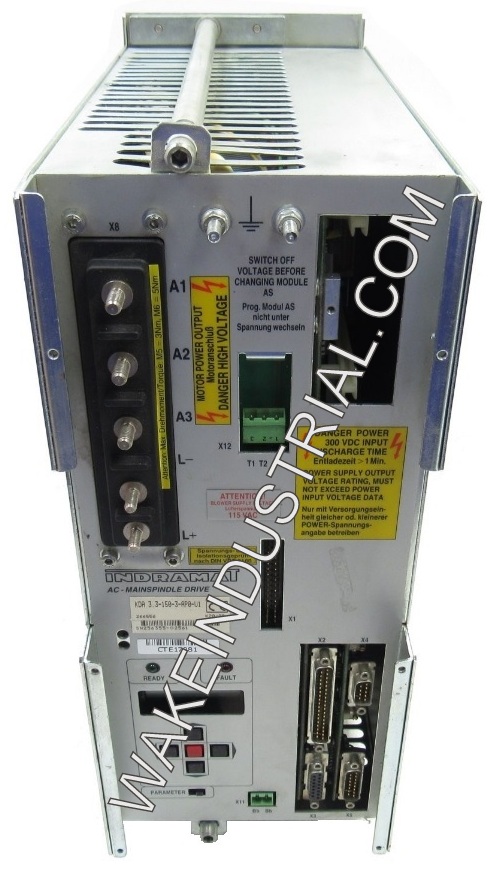
The Bosch Rexroth Indramat KDA 3.1-150-3-API-W1 is a spindle drive from the KDA Spindle Drives series. It features forced cooling with a mounted heatsink blower and operates with a rated current of 150 Amps. The unit accepts a DC supply voltage of 300 VDC and includes both incremental encoder output and a second encoder input for spindle or motor feedback.


To contact sales for pricing and lead time:
Payment Methods


Shipping Methods


Our Credentials


Product Description:
The KDA 3.1-150-3-API-W1 is a spindle drive produced by Bosch Rexroth Indramat within the KDA Spindle Drives series. It regulates three-phase spindle motors in milling, drilling, and grinding centers, receiving torque and speed commands from a higher-level numerical controller and applying them through its integrated power stage. By linking the DC bus of a compatible supply unit to the motor, the drive converts electrical energy into stable rotary motion for cutting processes that depend on accurate speed control. This operating role makes it suitable for machine tools that need steady spindle behavior during load changes, starts, and deceleration.
This drive draws its intermediate circuit potential from a 300 VDC link and can deliver a continuous output of 150 A, allowing large-frame synchronous or induction spindles to follow programmed acceleration profiles. Thermal management relies on forced cooling through a mounted heat sink blower, which moves air directly across the external fins to keep semiconductor temperatures within an acceptable operating range. The blower is supplied from a separate single-phase line of 220 V/50–60 Hz, so the installation requires an auxiliary branch circuit. Within an ambient range of 5 °C to 45 °C, this cooling method supports rated current during sustained spindle operation.
Installation is permitted up to 1000 m above sea level, allowing full output in most industrial locations without additional derating. Interface flexibility is supported by an incremental encoder output that passes real-time position data to external displays or supervisory controllers, and a second feedback channel is provided for spindle feedback or additional motor feedback when dual-loop control is required. The velocity setpoint is accepted as an analog command, which simplifies connection to legacy CNC systems that use ±10 V references. This signal arrangement allows the drive to work with both established machine platforms and newer control architectures.









