


KDA 3.1-100-3-L0S-U1 Bosch Rexroth Indramat
Wake Industrial LLC is not an authorized distributor of this product.
- Straightforward Pricing: No Rush Fees, No Credit Card Fees
Current response time:
6 Minutes
34 Seconds
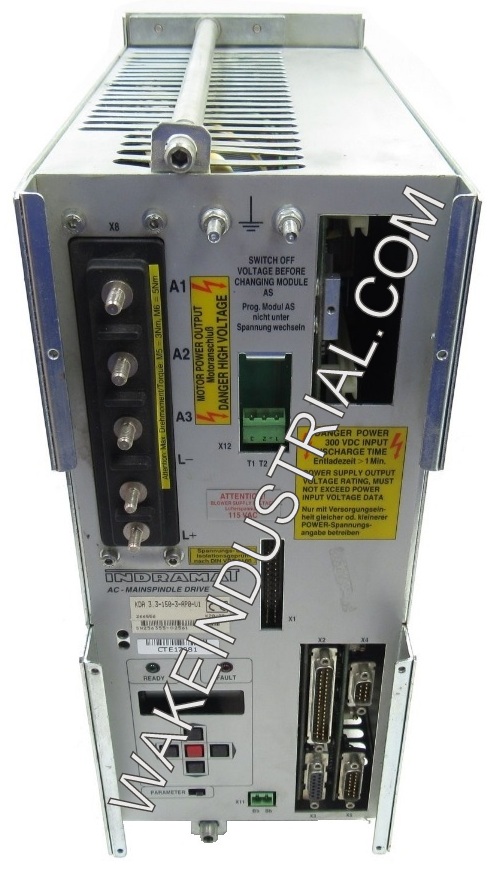
The Bosch Rexroth Indramat KDA 3.1-100-3-L0S-U1 is a spindle drive from the KDA Spindle Drives series. It operates with a rated current of 100 Amps and uses a 300 VDC supply voltage. The drive features forced cooling with a mounted heatsink blower that runs on 115V at 50-60Hz and is designed for ambient temperatures between 5 to 45 degrees Celsius.


To contact sales for pricing and lead time:
Payment Methods


Shipping Methods


Our Credentials


Product Description:
The KDA 3.1-100-3-L0S-U1 spindle drive is produced by Bosch Rexroth Indramat for the KDA Spindle Drives series. As a regenerative power module, it governs induction or synchronous spindles in metal-cutting and forming equipment, converting common DC bus energy into precise three-phase currents under closed-loop speed control. When the spindle decelerates, regenerated energy can be returned to the shared DC bus instead of being wasted as heat. Integrated diagnostics and fieldbus communication allow the drive to coordinate spindle motion with surrounding CNC axes while helping the control system monitor operating status. This supports stable speed control during cutting and forming processes where load conditions can change quickly.
The power section is supplied from a constant link of 300 VDC, and its inverter can deliver a continuous armature current of 100 A for rapid acceleration of large-diameter spindles. Thermal energy from the power semiconductors is removed by a mounted heat sink blower, and this fan is powered from an auxiliary source rated at 115 V/50-60 Hz. Airflow passes across the external heat sink, and the assembly operates with forced cooling to keep semiconductor temperatures within acceptable limits during high-duty cycles. The separate blower supply helps maintain cooling performance during extended operation and supports steady thermal behavior under changing spindle loads.
Operation is permitted in an ambient range of 5 to 45 °C and at mounting altitudes up to 1000 m above sea level. Parameter access and service data are available through a serial interface (RS-232C), while real-time velocity commands enter the controller through a SERCOS interface fiber ring. A second encoder input is not provided, so the controller processes only the primary spindle feedback. Separating service communication from the motion network allows diagnostics and parameter access without changing the cyclic command channel. This arrangement suits spindle applications that rely on one main feedback channel for speed and position supervision.









