


KDA 3.1-100-3-DQD-W1 Bosch Rexroth Indramat
Wake Industrial LLC is not an authorized distributor of this product.
Wake Industrial LLC is not an authorized distributor of this product.
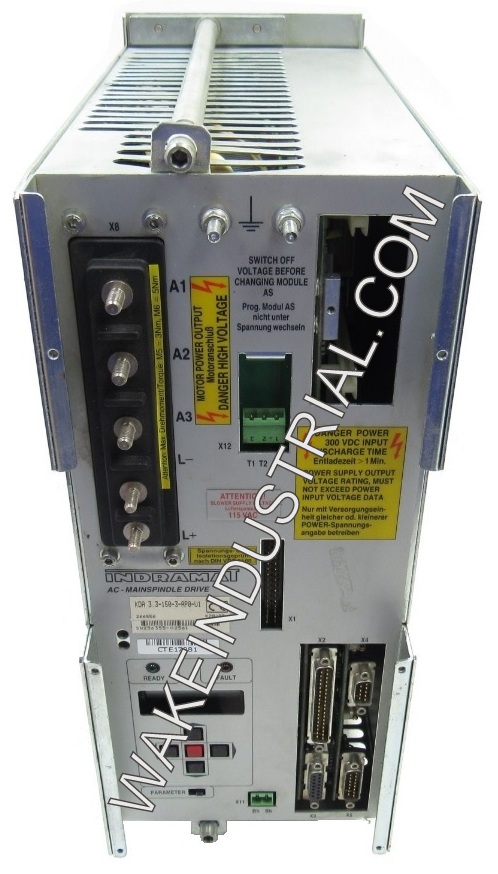
The Bosch Rexroth Indramat KDA 3.1-100-3-DQD-W1 is a spindle drive from the KDA Spindle Drives series. It features a rated current of 100 Amps and operates with a DC supply voltage of 300 VDC. The unit uses forced cooling with a mounted heatsink blower, and accepts 220V for the blower at 50-60 Hz.
Internal Product Review
The KDA 3.1-100-3-DQD-W1 spindle drive from Bosch Rexroth Indramat features a mounted heatsink blower and forced cooling for efficient thermal management. With a 100 A rated current and 300 VDC supply voltage, this unit handles demanding spindle applications with ease. The digital interfaces for position and speed command value further enhance system integration and control.
 Have a part to sell?
 Wake Industrial Warranty
To contact sales for pricing and lead time:
Payment Methods


Shipping Methods


Our Credentials


Product Description:
The KDA 3.1-100-3-DQD-W1 spindle drive is produced by Bosch Rexroth Indramat and belongs to the KDA Spindle Drives series. In machining centers and grinding applications, the unit modulates armature current to regulate spindle speed and torque in a closed loop. A dedicated DC bus links the drive to the system converter so the module can operate as the power stage for high-speed spindle axes. The drive is Series 3, indicating updated internal components and support for newer diagnostic and communication functions. In automated production lines, it provides fast acceleration during spindle starts while maintaining position accuracy during tool changes.
The power section is energized from a common bus at 300 VDC, so the upstream supply and regenerative circuits must be sized for that link voltage. Under continuous operation, the drive can deliver 100 A, which supports large synchronous spindle motors that require high armature current while cutting. The heat sink blower is powered from an auxiliary line of 220 V, 50–60 Hz, which separates cooling power from the logic supply and helps maintain airflow during a DC bus dropout. Proper thermal performance requires ambient air between 5 to 45 °C, and installation must remain below 1000 m above sea level to avoid derating for thin air.
Thermal management is handled by a mounted heat sink blower that draws air through the aluminum fins, and this arrangement works with forced cooling to keep the power module within its intended temperature range during rapid speed changes and repeated duty cycles. Command inputs are exchanged through a parallel bus, where the speed reference arrives as 16-bit digital parallel words. A separate channel accepts a digital position command value signal for coordinated motion with the CNC controller. These interfaces reduce conversion jitter compared with analog voltages and remove the need for external converters in digitally controlled CNC systems.