


KDA 3.1-100-3-DPS-W1 Bosch Rexroth Indramat
Wake Industrial LLC is not an authorized distributor of this product.
- Straightforward Pricing: No Rush Fees, No Credit Card Fees
Current response time:
5 Minutes
14 Seconds
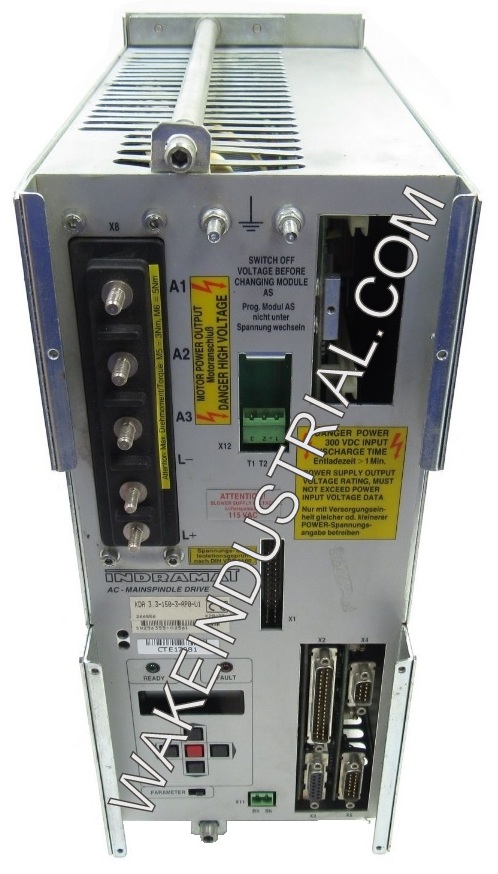
The Bosch Rexroth Indramat KDA 3.1-100-3-DPS-W1 is a spindle drive in the KDA Spindle Drives series. It features a rated current of 100 Amps and operates with a 300 VDC supply voltage. The drive is equipped with a mounted heatsink blower for forced cooling and has a serial interface for communication.


To contact sales for pricing and lead time:
Payment Methods


Shipping Methods


Our Credentials


Product Description:
The KDA 3.1-100-3-DPS-W1 is a spindle drive developed by Bosch Rexroth Indramat for the KDA Spindle Drives series. In a machining center or automated production cell, the unit supplies closed-loop power to high-speed spindle motors, translating digital speed commands from the CNC into precise armature currents. By coordinating acceleration, deceleration, and torque control, it supports accurate cutting, drilling, and grinding cycles in industrial automation. Its internal control section accepts multiple feedback channels to maintain stable spindle regulation during rapid speed changes and steady operation under load.
The drive’s power stage is energized from a DC bus at 300 VDC, and it can deliver a continuous output of 100 A to the spindle windings. Thermal stability is maintained by a mounted heat sink blower that directs air across the power semiconductors; the blower is supplied from an auxiliary line rated 220 V/50-60 Hz. Because the cooling path uses forced cooling, the unit can sustain full current capability during prolonged high-speed cutting without derating. Airflow across the heat sink also helps protect the switching devices during repeated acceleration and braking cycles.
During installation, the controller must sit in an enclosure where the surrounding air remains from 5 to 45 °C and the cabinet is positioned no higher than 1000 m above sea level. A digital 16-bit parallel interface supplies the primary speed command, while an RS-232-C serial interface handles diagnostic and parameter exchanges. An additional encoder socket is available for spindle or auxiliary motor feedback, so the axis computer can verify actual speed without relying solely on the main resolver. This communication arrangement separates the main command channel from service and monitoring functions.