


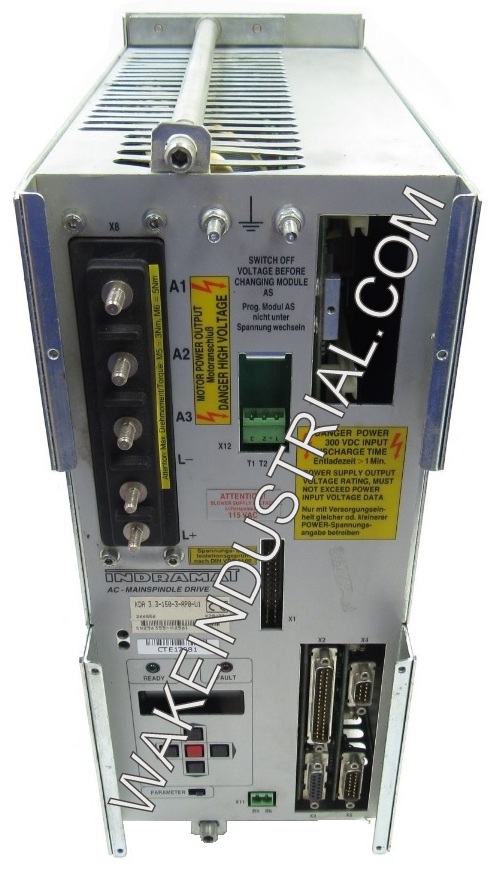
KDA 3.1-100-3-AQD-W1 Bosch Rexroth Indramat
Wake Industrial LLC is not an authorized distributor of this product.
Wake Industrial LLC is not an authorized distributor of this product.
The Bosch Rexroth Indramat KDA 3.1-100-3-AQD-W1 is a spindle drive from the KDA Spindle Drives series and has a rated current of 100 Amps. It uses forced cooling with a mounted heatsink blower supplied by 220 V at 50 to 60 Hz and weighs 17.1 kg. The drive supports a maximum installation elevation of 1000 meters above sea level and accepts analog speed command inputs of ±10 V.
Internal Product Review
The KDA 3.1-100-3-AQD-W1 spindle drive from Bosch Rexroth Indramat delivers impressive performance with a rated current of 100 A and continuous current of 70 A. Forced cooling is achieved via a mounted heatsink blower supplied by 220 V, ensuring reliable operation in demanding environments. Its digital position command interface and analog speed input make it a strong choice for precise spindle control applications.
 Have a part to sell?
 Wake Industrial Warranty
To contact sales for pricing and lead time:
Payment Methods


Shipping Methods


Our Credentials


Product Description:
The KDA 3.1-100-3-AQD-W1 belongs to the KDA Spindle Drives series produced by Bosch Rexroth Indramat. It is a spindle drive intended to regulate high-speed machining spindles by converting a fixed DC supply into controlled three-phase output while exchanging position and speed data with the numerical control system. A mounted heat sink and a dedicated blower let the unit dissipate heat so the spindle can hold speed during deep cuts or rapid accelerations in industrial automation cells. This arrangement suits machine tools that require stable spindle regulation during changing cutting loads.
The drive’s power stage is sized for a rated output of 100 A and can run continuously at 70 A when thermal limits are observed. It draws energy from a common DC bus that sits at 300 V, and the internal logic uses a separate 300 VDC supply rail. A forced-air cooling path described as Forced Cooling moves air through the mounted heat sink. Motor velocity is commanded through an analog ±10 V speed input, while a separate 16-bit digital position channel supports contouring moves. This combination allows the same unit to manage speed control and spindle orientation functions without additional interface cards.
Low-power electronics are supplied from a control rail that must furnish 1.4 A at 24 V. The blower itself can be powered by a plant utility supply of 220 V at 50 or 60 Hz, and the auxiliary encoder socket expects a differential signal of 1 Vpp. Interfaces for digital position command values and other discrete signals are presented on a separate header, giving the CNC access to in-process spindle orientation. The separate signal connections help keep low-level command wiring isolated from the power section. Operation is permitted between 5 °C and 45 °C at elevations up to 1000 m above sea level, and the aluminum housing weighs 17.1 kg.









