


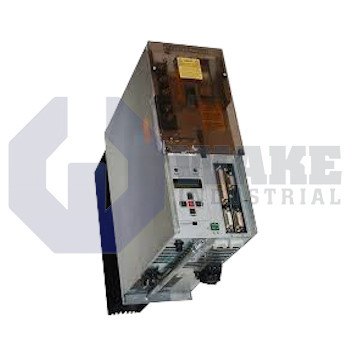
KDA 2.1-150-3-LPD-U1 Bosch Rexroth Indramat
Wake Industrial LLC is not an authorized distributor of this product.
Wake Industrial LLC is not an authorized distributor of this product.
The Bosch Rexroth Indramat KDA 2.1-150-3-LPD-U1 is a spindle drive from the KDA Spindle Drives series with a rated current of 150 Amps and a DC supply voltage of 300 Volts. It features forced cooling with a mounted heatsink blower powered by a 115V AC source and supports a SERCOS interface for speed command value input. The unit operates within an ambient temperature range of 5 to 45 degrees Celsius and can be installed up to 1000 meters above sea level.
Internal Product Review
The KDA 2.1-150-3-LPD-U1 is a spindle drive from Bosch Rexroth Indramat, equipped with a 150 A rated current and a 300 VDC supply voltage. Forced cooling is efficiently managed with a mounted heatsink blower powered by a 115V/50-60Hz AC source. This unit stands out for reliable high-current operation and enhanced cooling performance in demanding spindle applications.
 Have a part to sell?
 Wake Industrial Warranty
To contact sales for pricing and lead time:
Payment Methods


Shipping Methods


Our Credentials


Product Description:
The KDA 2.1-150-3-LPD-U1 is a spindle drive manufactured by Bosch Rexroth Indramat for the KDA Spindle Drives series. It converts bus power into controlled three-phase output for high-speed machine-tool spindles, closing torque and speed loops in coordination with CNC or PLC controllers. By integrating a heat sink blower and multiple feedback channels, the drive maintains thermal stability and position accuracy during continuous machining cycles. It is intended for precision spindle applications where stable speed response supports consistent cutting performance during long production runs.
This unit supplies the motor with up to 150 A of continuous current, giving it the headroom needed for rapid acceleration and heavy-cut torque demands. It is powered from a shared DC link held at 300 VDC, so several drives can draw energy from the same supply without additional converters. Thermal energy is removed by a mounted heat sink blower, a forced-air module fixed directly to the rear plate that keeps semiconductor junctions below their rated temperature. The blower operates from a separate 115 V/50–60 Hz source, which isolates cooling airflow from drive bus disturbances. For speed regulation, reference values are transferred through the SERCOS interface, enabling deterministic communication with motion controllers and simplifying fiber-optic wiring inside the cabinet.
Position loops use a digital position command value channel that carries absolute path data at high update rates, and a second encoder input is available when the spindle or an auxiliary axis requires additional feedback. The electronics are specified for ambient rooms kept between 5 °C to 45 °C, which helps maintain stable operation during normal machine-room service. Installations are permitted up to 1000 m above sea level, where reduced air density still allows the forced-air cooler to support the power section. Separate command and feedback paths also help the control system respond quickly to changing spindle loads during operation.









