


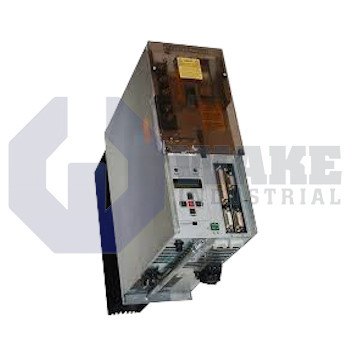
KDA 2.1-150-3-L00-W1 Bosch Rexroth Indramat
Wake Industrial LLC is not an authorized distributor of this product.
Wake Industrial LLC is not an authorized distributor of this product.
The Bosch Rexroth Indramat KDA 2.1-150-3-L00-W1 is a spindle drive from the KDA Spindle Drives series, featuring a rated current of 150 Amps and a DC supply voltage of 300 VDC. It has forced cooling with a mounted heatsink blower powered by a 220V AC source and operates in ambient temperatures from 5 to 45 degrees Celsius. The unit supports speed command via SERCOS interface and can be installed at elevations up to 1000 meters above sea level.
Internal Product Review
The KDA 2.1-150-3-L00-W1 spindle drive from Bosch Rexroth Indramat delivers impressive performance with a rated current of 150 A and stable operation under a DC supply voltage of 300 VDC. It utilizes a mounted heatsink blower and forced cooling mode, ensuring effective thermal management in demanding applications. The inclusion of the SERCOS interface for speed command highlights this drive's compatibility with advanced automation systems.
 Have a part to sell?
 Wake Industrial Warranty
To contact sales for pricing and lead time:
Payment Methods


Shipping Methods


Our Credentials


Product Description:
Bosch Rexroth Indramat manufactures the KDA 2.1-150-3-L00-W1, a digital spindle drive in the KDA Spindle Drives series. The module converts supplied DC bus energy into a three-phase output that controls high-speed motor spindles in CNC machining centers, drilling stations, and automated production lines. By working with Indramat power supplies and motion controllers, it supports spindle operation during rapid tool changes and during cutting, grinding, or finishing tasks that require stable speed. Its design supports both synchronous and asynchronous spindle motors, so it can be used across a broad range of machine layouts where closed-loop spindle regulation is required.
The internal inverter bridges draw power from a DC link held at 300 VDC. This bus voltage feeds the IGBT stage and the main power section of the drive. Continuous output current is rated at 150 A, providing headroom for aggressive acceleration without exceeding thermal limits. Heat generated by the drive circuitry is removed through a heat sink-mounted blower, and its fan motor is supplied by an auxiliary line of 220 V, 50/60 Hz. Because the blower pushes air across the fins, the unit uses forced cooling during prolonged high-current operation. The drive does not include additional fieldbus ports or a second encoder input, which keeps the interface layout straightforward.
All control data, including speed setpoints and diagnostic feedback, travel over a single SERCOS interface, which keeps communication deterministic and reduces the need for separate control links. The optical communication path supports coordinated spindle control within the surrounding automation system. Acceptable ambient conditions fall between 5–45 °C, and temperatures outside that range can reduce thermal margin. Installation is recommended below 1000 m elevation because lower air density reduces cooling effectiveness and may require derating. The unit is in release 2.









