


KDA 2.1-150-3-DQS-U1 Bosch Rexroth Indramat
Wake Industrial LLC is not an authorized distributor of this product.
Wake Industrial LLC is not an authorized distributor of this product.
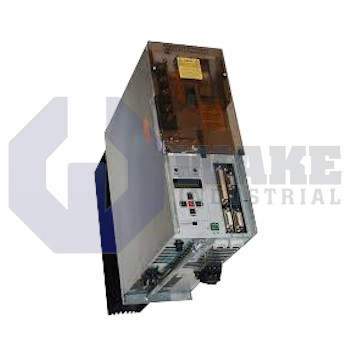
The Bosch Rexroth Indramat KDA 2.1-150-3-DQS-U1 is a spindle drive from the KDA Spindle Drives series with a rated current of 150 Amps and requires a 300 VDC supply voltage. It features forced cooling using a mounted heatsink blower and supports serial interfaces such as RS 232 C. The drive is designed to operate in temperatures ranging from 5 to 45 degrees Celsius at elevations up to 1000 meters above sea level.
Internal Product Review
The KDA 2.1-150-3-DQS-U1 spindle drive from Bosch Rexroth Indramat delivers dependable performance with a rated current of 150 A and a DC supply voltage of 300 VDC. Featuring a forced cooling system with a mounted heatsink blower and support for operation in ambient temperatures from 5 to 45 degrees Celsius, this model is engineered for continuous duty in demanding environments. The inclusion of a serial RS 232 C interface and digital 16-bit parallel speed command value further enhances system integration and precise control.
 Have a part to sell?
 Wake Industrial Warranty
To contact sales for pricing and lead time:
Payment Methods


Shipping Methods


Our Credentials


Product Description:
The KDA 2.1-150-3-DQS-U1 is a spindle drive produced by Bosch Rexroth Indramat for the KDA Spindle Drives series. It functions as the power and control module between the machine controller and an AC spindle motor, converting DC-bus energy into regulated three-phase output while processing high-resolution speed commands. In metal-cutting or grinding cells, the unit provides closed-loop spindle regulation coordinated with axis drives for consistent surface finish and cycle time. This operating role lets the spindle respond quickly to commanded speed changes during acceleration, deceleration, and changing cutting loads.
As a power stage, the drive delivers a rated current of 150 A, which is the continuous armature load it can supply without derating. It draws energy from a shared link operating at 300 VDC, so the supply and bleeder resistors must be sized for that voltage and transient energy. The integrated heat sink blower runs from 115 V/50–60 Hz, which keeps the cooling supply separate from the DC power section. A speed command value is accepted as 16-bit digital parallel, allowing numerical controllers to send precise setpoints without analog drift. For parameter loading, trace data, or fault investigation, communication is available through a serial interface (RS-232C).
Thermal management relies on a mounted heat sink blower, and airflow is provided by forced cooling to keep semiconductor temperature within the intended operating range during long production runs. The electronics remain stable within 5 to 45 °C, so cabinet cooling must keep the surrounding air inside that range during operation. Mechanical stress on components is acceptable up to 1000 m above sea level, which covers most industrial installation sites without additional derating. The blower-assisted airflow removes heat directly from the power section, helping the drive maintain stable spindle control during extended machining duty. Cabinet layout should also leave clear airflow paths so heated air does not collect around adjacent modules.









