


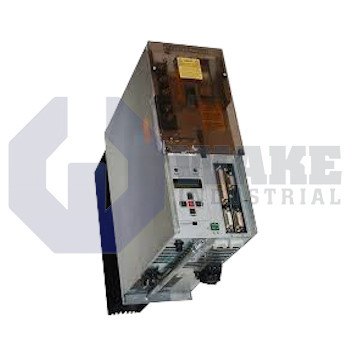
KDA 2.1-150-3-DPS-W1 Bosch Rexroth Indramat
Wake Industrial LLC is not an authorized distributor of this product.
Wake Industrial LLC is not an authorized distributor of this product.
The Bosch Rexroth Indramat KDA 2.1-150-3-DPS-W1 is a spindle drive from the KDA Spindle Drives series with a rated current of 150 Amps and operates on a 300 VDC supply voltage. It uses a forced cooling system with a mounted heatsink blower and is equipped with a serial interface (RS 232 C) and a second encoder input for spindle or motor feedback.
Internal Product Review
The KDA 2.1-150-3-DPS-W1 spindle drive from Bosch Rexroth Indramat features a rated current of 150 A and supports a DC supply voltage of 300 VDC, making it well-suited for demanding spindle applications. Forced cooling is efficiently managed by a mounted heatsink blower operating on 220V/50-60Hz, ensuring stable thermal performance. The inclusion of a serial interface (RS 232 C) and a secondary encoder input adds valuable flexibility for system integration.
 Have a part to sell?
 Wake Industrial Warranty
To contact sales for pricing and lead time:
Payment Methods


Shipping Methods


Our Credentials


Product Description:
The KDA 2.1-150-3-DPS-W1 is a spindle drive produced by Bosch Rexroth Indramat for the KDA Spindle Drives series. As a dedicated power module, it energizes and regulates machine-tool spindles by converting bus voltage into a controlled three-phase output while monitoring speed feedback. This allows the spindle to respond accurately to CNC commands during positioning, speed regulation, and contouring tasks. The unit is version 2 in the product line and provides the electrical link between the spindle and the control system for coordinated machine operation.
The drive is supplied from a shared bus at 300 VDC, and its power stage can deliver up to 150 A of continuous current to the motor. Heat from the IGBT section is removed by a mounted heat sink blower, and the cooling method uses forced cooling so airflow remains consistent during extended cutting duty. The cooling fan is powered by an auxiliary supply of 220 V, 50/60 Hz, which keeps the thermal system separate from variations on the DC link. This arrangement supports stable thermal performance during sustained spindle operation and helps the drive maintain predictable output under load.
System communication is handled through a serial interface (RS-232-C), and the control board also accepts a second encoder input for spindle or auxiliary motor position data. Target speed is sent as a 16-bit parallel digital command, which gives the control system fine command resolution for tasks such as tapping, threading, and synchronized tool changes. The unit maintains full electrical performance in ambient temperatures from 5 to 45 °C and at elevations up to 1000 m above sea level. These operating limits make the drive suitable for machining centers and turning stations that require reliable spindle control across normal industrial installation conditions.









