


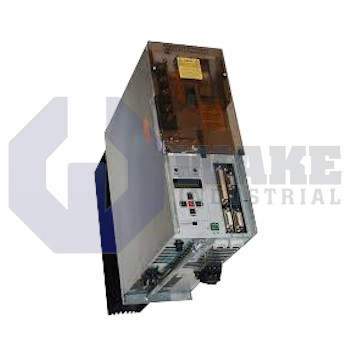
KDA 2.1-150-3-D00-W1 Bosch Rexroth Indramat
Wake Industrial LLC is not an authorized distributor of this product.
Wake Industrial LLC is not an authorized distributor of this product.
The Bosch Rexroth Indramat KDA 2.1-150-3-D00-W1 is a spindle drive from the KDA Spindle Drives series. It features a rated current of 150 Amps, operates on a 300 VDC supply voltage, and uses forced cooling with a mounted heatsink blower. The drive can be installed at elevations up to 1000 meters above sea level and supports a digital 16-bit parallel speed command value.
Internal Product Review
The KDA 2.1-150-3-D00-W1 spindle drive is a high-performance solution from the Bosch Rexroth Indramat KDA series, featuring a rated current of 150 A and a 300 VDC supply voltage. Forced cooling is provided by a mounted heatsink blower designed for 220V operation, supporting consistent performance in demanding environments. This drive stands out for its reliable power output and efficient thermal management.
 Have a part to sell?
 Wake Industrial Warranty
To contact sales for pricing and lead time:
Payment Methods


Shipping Methods


Our Credentials


Product Description:
The KDA 2.1-150-3-D00-W1 belongs to the KDA Spindle Drives series from Bosch Rexroth Indramat. It functions as a dedicated spindle drive, supplying regulated three-phase power to high-speed motor windings so machining centers can maintain commanded surface speeds and cutting forces during milling, drilling, and similar operations. By linking directly to the common DC bus in multi-axis systems, the drive closes the loop between numerical control commands and the mechanical spindle, supporting repeatable acceleration, deceleration, and positioning under changing process loads.
The internal power section operates from a DC link of 300 VDC, and its silicon devices are sized for a continuous output of 150 A. Speed information is accepted as a digital 16-bit parallel word, giving the controller fine resolution when calculating spindle velocity. Thermal management relies on a mounted heatsink blower; air is pulled across the finned aluminum plate, and the arrangement uses forced cooling to remove the switching and motor-generated heat that builds up during long cutting cycles. This combination suits heavy material-removal operations where large current pulses and accurate electronic speed references are required for stable spindle control.
The blower motor is supplied from an auxiliary line of 220 V 50-60 Hz, isolating the cooling circuit from the main DC path and simplifying cabinet wiring. Reliable operation is maintained within an ambient range of 5 to 45 °C, and the performance envelope remains valid up to 1000 m above sea level without derating. This separate fan supply keeps the cooling circuit independent from the main spindle power section during operation. There is no additional interface option, and the design omits a secondary encoder port, so all position or speed feedback must enter through the primary resolver channel.









