


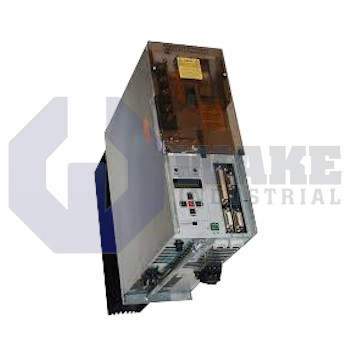
KDA 2.1-100-3-DPS-U1 Bosch Rexroth Indramat
Wake Industrial LLC is not an authorized distributor of this product.
- Straightforward Pricing: No Rush Fees, No Credit Card Fees
The Bosch Rexroth Indramat KDA 2.1-100-3-DPS-U1 is a spindle drive from the KDA Spindle Drives series with a rated current of 100 Amps and requires a 300 VDC supply voltage. It features a forced cooling system using a mounted heatsink blower and includes a serial interface (RS 232 C). Designed for operation at ambient temperatures between 5 and 45 degrees Celsius, it can be installed at elevations up to 1000 meters above sea level.


To contact sales for pricing and lead time:
Payment Methods


Shipping Methods


Our Credentials


Product Description:
The KDA 2.1-100-3-DPS-U1 spindle drive is manufactured by Bosch Rexroth Indramat and belongs to the KDA Spindle Drives series. It is a Series 2 module intended to control high-speed machine-tool spindles by converting a fixed DC bus into regulated three-phase output for metal-cutting and drilling operations. The housing combines current regulation, fault monitoring, and feedback handling so it can serve as the axis-specific power stage in an Indramat modular rack. This arrangement allows the drive to respond to changing spindle demand during continuous machining duty.
A DC bus link of 300 VDC supplies the power section inside the unit. The controller is rated for 100 A of continuous output so compatible motors can receive full torque at low speed. A digital 16-bit parallel command value provides the speed reference, allowing numerically controlled systems to transmit velocity data without analog drift. Thermal energy is carried away by a blower powered from an auxiliary line of 115 V at 50/60 Hz. Because the heat sink receives pressurized air, the drive uses forced cooling to control semiconductor temperature during sustained spindle duty. A second encoder input is also available, so spindle orientation or an additional motor channel can be handled without an external module.
For cabinet layouts, the active cooling element is a mounted heatsink blower, which reduces the need for separate airflow hardware around the module. Communication with diagnostic terminals or CNC controls is possible through a serial RS-232C interface, which supports parameter access and fault tracking. The permissible ambient range is 5 to 45 °C, and the unit may be installed up to 1000 m above sea level before derating is required. Operation beyond these limits can reduce cooling effectiveness and available output current.









