


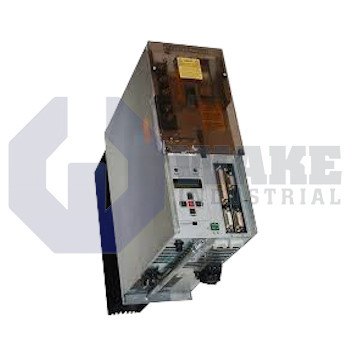
KDA 2.1-100-3-AYS-W1 Bosch Rexroth Indramat
Wake Industrial LLC is not an authorized distributor of this product.
- Straightforward Pricing: No Rush Fees, No Credit Card Fees
Current response time:
6 Minutes
12 Seconds
The Bosch Rexroth Indramat KDA 2.1-100-3-AYS-W1 is a spindle drive belonging to the KDA Spindle Drives series. This drive features a rated current of 100 Amps and operates with a DC supply voltage of 300 VDC. It uses forced cooling with a mounted heatsink blower, and supports a second encoder input and synchronous input.


To contact sales for pricing and lead time:
Payment Methods


Shipping Methods


Our Credentials


Product Description:
The KDA 2.1-100-3-AYS-W1 is a drive module engineered by Bosch Rexroth Indramat within the KDA Spindle Drives series. It converts a regulated DC bus into controlled three-phase output so high-speed machine-tool spindles can be started, accelerated, and held at precise rpm during cutting cycles. By providing closed-loop current and velocity regulation, the unit integrates into CNC cabinets where compact, panel-mounted spindle drives are required for automated milling, drilling, or grinding processes. This layout supports stable spindle control during changes in load, speed, and cutting conditions.
Rated for a continuous phase current of 100 A, the drive can supply the transient torque demands typical of spindle acceleration. Its internal power stage is energized from a DC link held at 300 VDC, a value produced by the companion supply module and routed on the common bus bars. Thermal energy from the IGBT stack is moved to an external finned plate that is cooled by a mounted heat sink blower. This fan is powered from an auxiliary line of 220 V/50–60 Hz. Because airflow is actively forced through the fins, the cooling mode is classified as forced cooling, which helps the unit maintain rated output during continuous high-speed machining sequences. The drive is in Series 2.
Operation remains stable between 5 to 45 °C ambient and up to 1000 m above sea level, so typical shop-floor conditions do not limit performance. A serial interface (RS-232-C) is provided for diagnostics and parameter transfer, while a second encoder and synchronous input permit positioning feedback when high-precision spindle orientation is required. The speed reference arrives as an analog command voltage, which simplifies connection to legacy motion controllers without requiring additional network hardware. This arrangement also supports integration in systems that use conventional command signals rather than digital communication links.









