


KDA 2.1-100-3-APD-U1 Bosch Rexroth Indramat
Wake Industrial LLC is not an authorized distributor of this product.
Wake Industrial LLC is not an authorized distributor of this product.
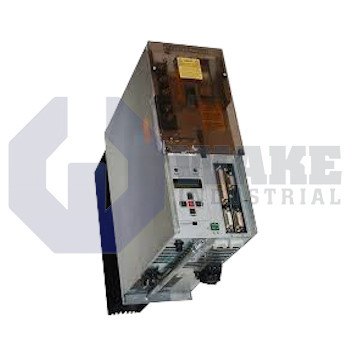
The Bosch Rexroth Indramat KDA 2.1-100-3-APD-U1 is a spindle drive from the KDA Spindle Drives series, featuring forced cooling with a mounted heatsink blower and operates at a rated current of 100 Amps. It accepts a DC supply voltage of 300 VDC, with an AC source for the heatsink blower of 115V at 50-60Hz, and supports both analog speed command values and digital position command inputs.
Internal Product Review
The KDA 2.1-100-3-APD-U1 spindle drive from Bosch Rexroth Indramat features a mounted heatsink blower with forced cooling, supporting continuous operation at ambient temperatures up to 45°C. With a rated current of 100 A and a 300 VDC supply voltage, this model is well suited for demanding spindle applications. Additional interfaces for digital position command and a second encoder input enhance system flexibility.
 Have a part to sell?
 Wake Industrial Warranty
To contact sales for pricing and lead time:
Payment Methods


Shipping Methods


Our Credentials


Product Description:
The KDA 2.1-100-3-APD-U1 is a spindle drive from Bosch Rexroth Indramat's KDA Spindle Drives series. In a machining center or grinding line, it converts the fixed DC link of a cabinet into the regulated three-phase output required to accelerate and decelerate a motorized spindle with precision. By combining high current capability with several command interfaces, the unit forms the link between a CNC controller and the mechanical spindle, managing torque, velocity, and position during metal-cutting and similar industrial tasks.
The drive draws its intermediate power from a DC bus rated at 300 VDC, and it can deliver up to 100 A of continuous output to the spindle windings, allowing rapid speed changes under heavy cutting loads. A dedicated heat sink blower runs from an auxiliary supply of 115 V/50-60 Hz, which keeps semiconductor temperatures within limits when the cabinet fan alone is insufficient. The blower is attached directly to the heat sink in a configuration described as a heat sink-mounted blower. The unit uses forced cooling, so thermal performance does not depend on natural convection or cabinet orientation, which is important in densely packed multi-axis systems.
The unit maintains full ratings in ambient conditions from 5 to 45 °C and at installation heights up to 1000 m above sea level. Control electronics accept a digital position command value for precise spindle orientation, while velocity is modified through an independent analog speed command value, letting a CNC program select either mode without rewiring. A secondary encoder socket is present for spindle or auxiliary motor feedback, and additional logic terminals transmit drive status to the higher-level controller so that thermal limits, current utilization, and motion commands remain synchronized with real-time machining requirements.









