


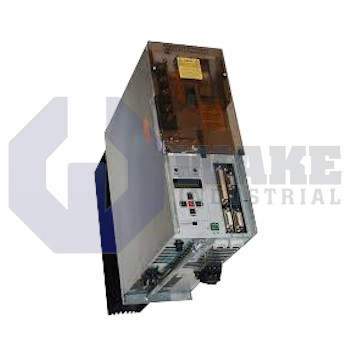
KDA 2.1-100-3-A0D-W1 Bosch Rexroth Indramat
Wake Industrial LLC is not an authorized distributor of this product.
Wake Industrial LLC is not an authorized distributor of this product.
The Bosch Rexroth Indramat KDA 2.1-100-3-A0D-W1 is a spindle drive in the KDA Spindle Drives series. It features a rated current of 100 Amps and operates with a DC supply voltage of 300 VDC. The unit uses a mounted heatsink blower for forced cooling and accepts position command values digitally and speed command values as analog signals.
Internal Product Review
The KDA 2.1-100-3-A0D-W1 spindle drive from Bosch Rexroth Indramat offers a 100 A rated current and operates on a 300 VDC supply, making it well-suited for demanding industrial spindle applications. Forced cooling is achieved with a mounted heatsink blower running on a 220V AC source for reliable thermal management. This model stands out with digital position command interface for precise control.
 Have a part to sell?
 Wake Industrial Warranty
To contact sales for pricing and lead time:
Payment Methods


Shipping Methods


Our Credentials


Product Description:
The KDA 2.1-100-3-A0D-W1 is a spindle drive manufactured by Bosch Rexroth Indramat as part of the KDA Spindle Drives series. In machine-tool and fabrication lines, a spindle drive regulates motor torque and speed so that the cutting spindle follows the set program without overshoot. This unit interfaces with higher-level motion controllers in multi-axis systems, allowing closed-loop speed control during coordinated motion. It is suited for spindle applications where the motor must respond quickly to command changes while maintaining stable rotation under varying process loads. Thermal load during high-current operation is handled by airflow across the heat sink assembly.
The drive draws its DC link from a bus rated at 300 VDC and delivers a continuous operating current of 100 A, giving it the headroom required for large-frame spindle motors. Internal electronics and power semiconductors are cooled by a mounted heat sink blower, and that blower is supplied from an auxiliary circuit rated at 220 V/50–60 Hz. Airflow through the fin stack provides forced cooling, which removes heat more effectively than natural convection. The unit’s velocity loop accepts a speed reference, while a separate port can receive position data for contouring. These signal paths are galvanically isolated from the power stage to reduce noise coupling inside the control cabinet.
Installation is permitted in continuous service from 5 to 45 °C and at elevations up to 1000 m above sea level without derating. The speed reference is provided as an analog input, and the controller can also process a digital position command value for coordinated moves. A second encoder input is not provided, so any feedback redundancy must be handled upstream. Series index 2 identifies the hardware generation. This arrangement supports integration into multi-axis systems that use a central controller to manage spindle speed and position commands.









