


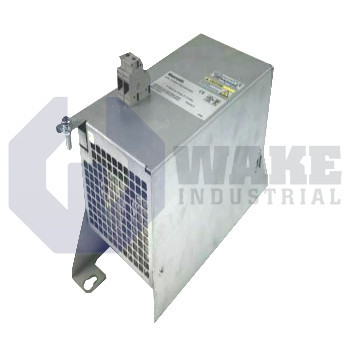
HLR01.1N-03K5-N16R0-A-007-NNNN Bosch Rexroth Indramat
Wake Industrial LLC is not an authorized distributor of this product.
Wake Industrial LLC is not an authorized distributor of this product.
MPN: R911324299
Ask for AvailabilityThe Bosch Rexroth Indramat HLR01.1N-03K5-N16R0-A-007-NNNN is a brake resistor in the HLR Brake Resistors series with a braking power of 3.5 kW and braking resistance of 40 Ohms. The unit has dimensions of 490 mm in depth, 270 mm in height, and 295 mm in width, with a weight of 9.5 kilograms, and an energy consumption of 180 kilowatt-seconds.
Internal Product Review
The HLR01.1N-03K5-N16R0-A-007-NNNN is a brake resistor rated for 3.5 kW braking power and 40 Ω braking resistance. A 9.5 kg build and 4.5 s max on time support dependable integration in dynamic braking circuits. Strong 180 kWs energy handling makes this model an excellent choice for controlled deceleration duty.
 Have a part to sell?
 Wake Industrial Warranty
To contact sales for pricing and lead time:
Payment Methods


Shipping Methods


Our Credentials


Product Description:
The HLR01.1N-03K5-N16R0-A-007-NNNN is a brake resistor produced by Bosch Rexroth Indramat for the HLR Brake Resistors series, and it connects to regenerative drive controllers to convert surplus kinetic energy into heat. By pairing with the DC bus of an inverter, the module helps prevent overvoltage events during rapid deceleration or load reversal cycles in automated machinery. During braking, regenerated energy is diverted away from the drive electronics and discharged through the resistor element instead of raising bus voltage inside the system. This makes the unit useful in material-handling lines, servo-actuated assembly stations, and other motion platforms that generate repeated braking energy.
Nominal thermal capacity is rated at 3.5 kW, so the resistor can continuously absorb that amount of electrical power without exceeding its temperature limit. The element’s dissipative value is 40 Ω, so current flow at a given DC-bus voltage stays within the intended braking range and supports controlled energy dissipation. A permissible duty of 4.5 s marks the longest single braking interval before a cooling pause is required, while the energy storage figure of 180 kWs indicates how much kinetic or potential energy can be removed during one event. These values help match braking demand to the resistor’s thermal recovery behavior during repetitive deceleration cycles.
Installation planning must account for a mass of 9.5 kg, which affects panel support and mounting load. The housing occupies a vertical envelope of 270 mm in height, spans 295 mm in width, and projects 490 mm in depth, so enclosure airflow paths should leave open space around the unit for heat release. Because the resistor relies on free air movement rather than forced cooling, tight cabinet layouts can trap heat near adjacent components during frequent braking. Adequate spacing around the enclosure helps dissipate heat from the housing surfaces and keeps temperature rise under control during repeated energy absorption.