


HDS03.2-W100N-HS54-01-FW Bosch Rexroth Indramat
Wake Industrial LLC is not an authorized distributor of this product.
- Straightforward Pricing: No Rush Fees, No Credit Card Fees
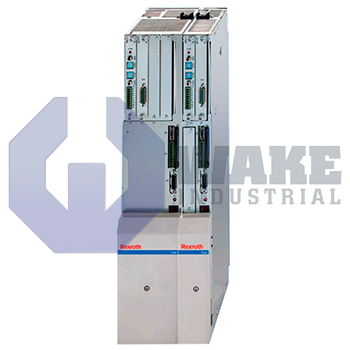
The Bosch Rexroth Indramat HDS03.2-W100N-HS54-01-FW is a drive controller in the HDS Drive Controllers series and part of the DIAX04 controller family. It features a SERCOS command communication interface, a built-in internal air blower for cooling, and is rated for 100 Amps of current.


To contact sales for pricing and lead time:
Payment Methods


Shipping Methods


Our Credentials


Product Description:
The HDS03.2-W100N-HS54-01-FW is a drive controller produced by Bosch Rexroth Indramat for the HDS Drive Controllers series. Within multi-axis systems, it serves as the axis module between the higher-level controller and the connected motor. It regulates the current delivered to the axis so commanded acceleration, speed, and position can be carried out with repeatable motion. This operating role fits automated equipment that depends on synchronized movement across several driven axes.
This unit exchanges real-time setpoints and status over the SERCOS fiber-optic interface, allowing phase-synchronous communication between multiple axes and the PLC. A continuous output capability of 100 A lets it energize medium-to-large Indramat motors while maintaining the protective functions built into the controller family. Thermal management is handled by a built-in air blower, and cabinet air is drawn through the heat sink so no separate external cooling module is required. The controller is part of the DIAX04 platform, which uses a common module format for coordinated multi-axis operation. Its designation places it in Line 03, which matches the mechanical dimensions and connector layout used with compatible supply units on the same power rail.
The unit is identified as Version 2, which marks a later revision within this product line. As an intelligent axis module, it is intended for cabinet-mounted drive arrangements where several coordinated axes share control and power infrastructure. The controller manages closed-loop motion behavior rather than operating as a standalone supply device, so it is installed with related system modules in the same drive assembly. Its function centers on precise axis response during repeated machine cycles, including applications that require synchronized starts, stops, and speed changes.









