


HDS03.2-W100N-HS Bosch Rexroth Indramat
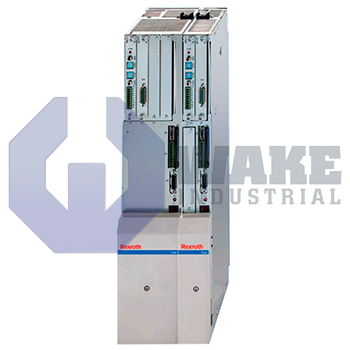
Wake Industrial LLC is not an authorized distributor of this product.
- Straightforward Pricing: No Rush Fees, No Credit Card Fees
The Bosch Rexroth Indramat HDS03.2-W100N-HS is a drive controller from the HDS Drive Controllers series and belongs to the DIAX04 controller family. It features a rated current of 100 Amps and is equipped with a SERCOS command communication interface. This drive controller uses a built-in internal air blower for cooling.


To contact sales for pricing and lead time:
Payment Methods


Shipping Methods


Our Credentials


Product Description:
The HDS03.2-W100N-HS is a modular drive controller manufactured by Bosch Rexroth Indramat for the HDS Drive Controllers series. It is intended for servo and spindle regulation in multi-axis machining centers, packaging systems, and transfer lines where coordinated motion is required over repeated production cycles. The unit receives setpoint data from a master motion processor and produces three-phase outputs so that connected motors follow programmed speed or torque profiles inside industrial automation cells. This makes it suitable for machines that need stable axis control during acceleration, deceleration, and steady-speed operation.
This controller exchanges cyclic data over the SERCOS fiber-optic ring, a deterministic interface that supports real-time diagnostics, synchronized data transfer, and stable communication with higher-level motion control. It belongs to the DIAX04 controller family, allowing it to slot into common backplanes with compatible DSM or DKC modules for coordinated operation. Thermal management is handled by a built-in air blower; the fan draws cabinet air through the heat sink to keep the power section within its operating temperature range. The output stage is rated for 100 A continuous current, so the unit can supply large servo or spindle motors without an external booster stage. The unit is assigned to Line 03.
The product is Version 2. It is an HDS drive controller with a single-axis format, which distinguishes it from power supplies in the same product range. Protective logic trips on overcurrent, overtemperature, or communication loss so the controller can shut down safely when a fault occurs. The controller monitors these conditions internally and interrupts output when a fault is detected, helping protect connected motors and the power electronics during abnormal operation.









