


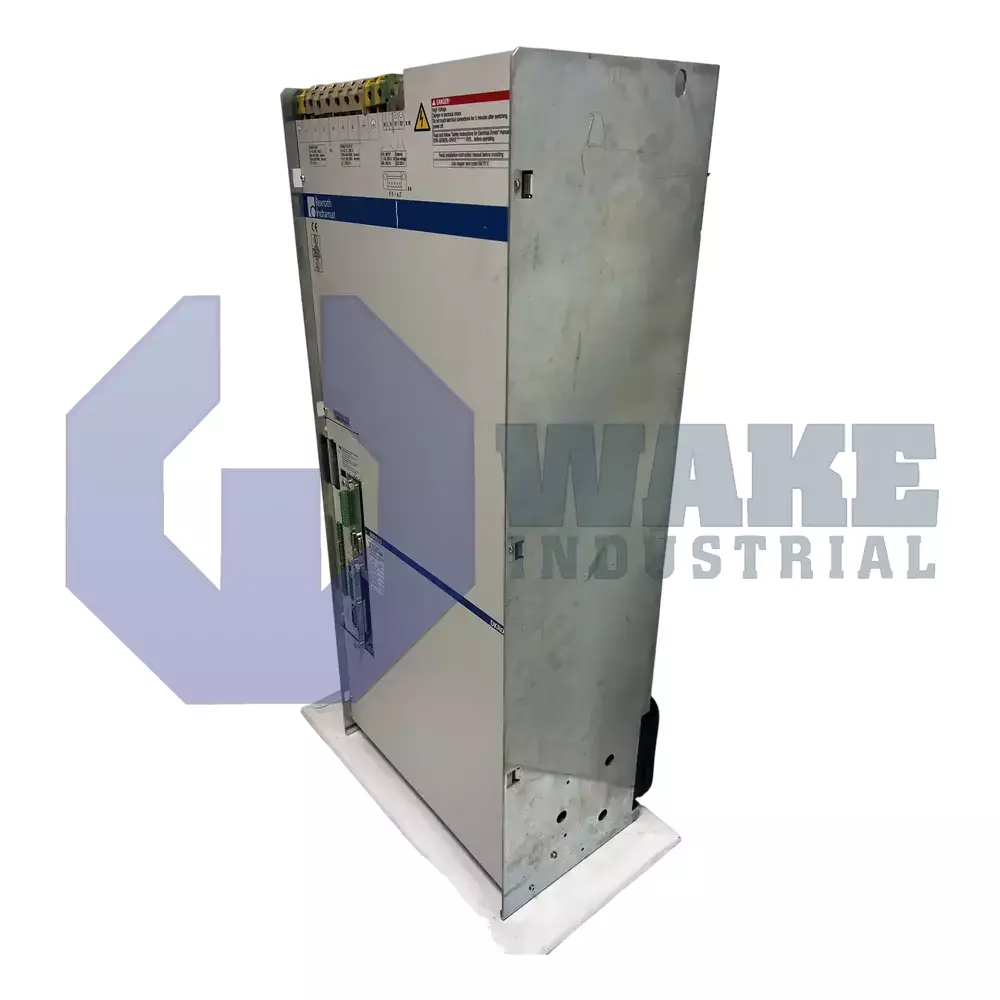
DKR02.1-W200N-BA04-01-FW Bosch Rexroth Indramat Analog Interface Digital Servo Drive Controller
Wake Industrial LLC is not an authorized distributor of this product.
Wake Industrial LLC is not an authorized distributor of this product.
MPN: R911283505
The Bosch Rexroth Indramat DKR02.1-W200N-BA04-01-FW is part of the DKR Drive Controllers series and has a weight of about 104 kilograms. It features a continuous current of 120 Amps at 4 kHz, a peak current of 141 Amps, and a continuous power output of roughly 47 kilowatts. This digital intelligent AC drive controller uses an analog interface for commands and supports both digital servo and resolver feedback.
Internal Product Review
The DKR02.1-W200N-BA04-01-FW is a digital intelligent AC drive controller with an analog interface. Air cooling from the built-in blower and rated power voltage of 3xAC 400 to 480 V support dependable integration in demanding motion systems. Continuous power of about 47 kW at 4 kHz stands out as a strong performance advantage for high-load applications.
 Have a part to sell?
 Wake Industrial Warranty
To contact sales for pricing and lead time:
Payment Methods


Shipping Methods


Our Credentials


Product Description:
The DKR02.1-W200N-BA04-01-FW is a digital intelligent AC drive controller produced by Bosch Rexroth Indramat as part of the DKR Drive Controllers series. It converts the three-phase mains supply into regulated DC and inverter output that powers servo or spindle motors used in machining centers, printing lines, and other automated stations. By combining supply, regulation, and fault monitoring in one chassis, the unit streamlines cabinet layouts and supports coordinated multi-axis motion.
At a 4 kHz switching frequency, the inverter can deliver a continuous armature current of 120 A, corresponding to a continuous mechanical output of 47 kW. Control electronics are fed from a single-phase auxiliary supply of AC 230 V ±10%, while the power section accepts a three-phase input range of 3xAC 400–480 V ±10%. Internal air cooling provided by a built-in blower forces heat away from the IGBTs so the drive can maintain its rated output during high-duty machining cycles. Digital servo and resolver feedback channels are interpreted in real time to close the current and velocity loops, and the rigid DC bus design removes the need for a brake chopper when decelerating typical inertial loads.
The peak current capacity rises to 141 A for short acceleration demands, and overall thermal losses are limited to 1600 W, a value that must be removed by enclosure airflow. The housing, including the blower, weighs 104 kg, so mounting provisions should account for this mass when arranging drive stacks on the cabinet backplate. Command signals arrive through an analog interface, while position data return through the digital feedback ports. Current rating code 200, design version 1, function module version 01, and line series 02 identify the unit within the DKR family. The rigid DC bus does not use a bleeder and can handle braking demands from motor sets with moderate inertia.









