


DKC06.3-016-7-FW Bosch Rexroth Indramat
Wake Industrial LLC is not an authorized distributor of this product.
Wake Industrial LLC is not an authorized distributor of this product.
MPN: R911292832
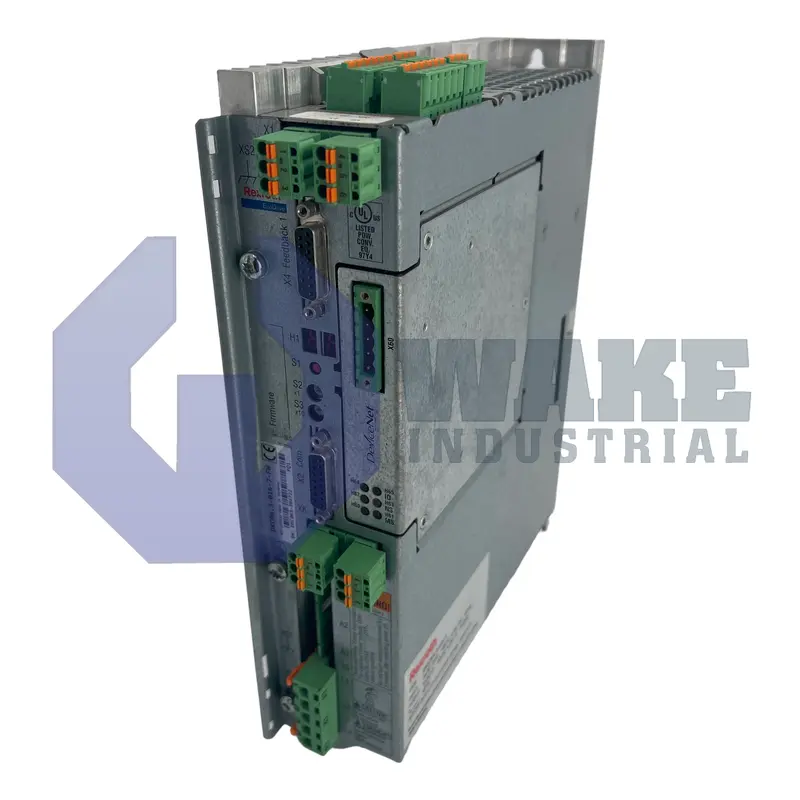
The Bosch Rexroth Indramat DKC06.3-016-7-FW is an EcoDrive from the DKC Drive Controllers series with a rated current of 16 Amps and a DC-bus nominal voltage of 700 Volts. This controller features a maximum motor cable length of 75 meters and supports a brake loop current of 10 Amps DC.
Internal Product Review
The DKC06.3-016-7-FW is a Bosch Rexroth Indramat EcoDrive controller with a 700 V DC-bus nominal voltage and 16 A rated current. A 75 m maximum motor cable length and 10 ms PLC evaluation delay support responsive control and flexible machine integration. A highly capable option for motion applications needing dependable drive performance.
 Have a part to sell?
 Wake Industrial Warranty
To contact sales for pricing and lead time:
Payment Methods


Shipping Methods


Our Credentials


Product Description:
The DKC06.3-016-7-FW belongs to the DKC Drive Controllers series produced by Bosch Rexroth Indramat. It is an EcoDrive unit that operates as a closed-loop servo drive, converting DC-bus energy into three-phase output for synchronous or induction motors. Within an automation cell, it receives motion commands from a PLC, regulates motor torque and velocity, and returns status data to higher-level control. Because the drive closes its regulation loops internally, the external controller can issue motion commands while the unit manages current delivery at the motor terminals.
The drive’s DC link is rated at 700 V, giving the internal inverter enough voltage margin to supply high-speed motors without field weakening. Continuous output is limited to a rated current of 16 A, which is relevant when sizing conductors, fuses, and cabinet thermal management. Motor leads may be routed up to 75 m before signal quality and dV/dt limits require additional filtering, allowing more flexibility when the controller cannot be mounted directly at the machine base. Command terminals have an input resistance of 13.3 kΩ ±5%, so low-level logic cards can drive them without excessive loading. The PLC evaluation delay is 10 ms, so control programs must account for this fixed latency during fast machine responses. This behavior matters in compact cabinets where cable routing, ventilation, and response time all affect axis performance.
Dynamic braking energy is handled through an external loop that may conduct up to 10 A DC. The associated conductors need a cross-section of 2.5 mm² to limit temperature rise during repetitive deceleration cycles. Motor cables introduce capacitive coupling of 0.5 nF/m core-to-core and distributed inductance of 100 nH/m, and these line characteristics affect rise times, common-mode currents, and the choice of output filtering. On longer cable runs, these values can also influence shielding layout and the selection of suppression components near the drive output. Cable behavior and braking circuit loading should be considered when the drive is installed in long-cable or high-duty applications.