


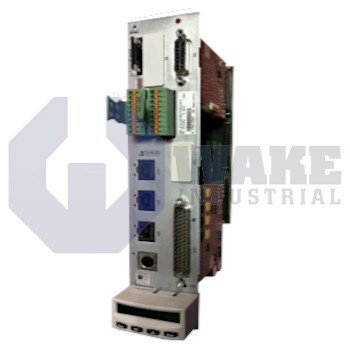
CSH01.2C-PB-ENS-MEM-CCD-L1-S-NN-FW Bosch Rexroth Indramat
Wake Industrial LLC is not an authorized distributor of this product.
MPN: R911317396
No Tariffs On US Orders- Straightforward Pricing: No Rush Fees, No Credit Card Fees
Current response time:
3 Minutes
28 Seconds
The Bosch Rexroth Indramat CSH01.2C-PB-ENS-MEM-CCD-L1-S-NN-FW is part of the CSH Advanced Controllers series and features both absolute and incremental encoder emulation with an ENS encoder interface. It offers SERCOS III cross communication, master communication via PROFIBUS-DP, and operates at a maximum switching frequency of 16 kHz. The controller supports an encoder output current of 20 mA and has a power consumption of 8.5 watts.


To contact sales for pricing and lead time:
Payment Methods


Shipping Methods


Our Credentials


Product Description:
The CSH01.2C-PB-ENS-MEM-CCD-L1-S-NN-FW belongs to the CSH Advanced Controllers series from Bosch Rexroth Indramat and serves as a control section for drive-based automation. It is equipped with a PROFIBUS-DP master interface for fieldbus coordination and uses SERCOS III for cross-communication between drives. The unit reads position data through an ENS encoder interface that accepts SSI absolute signals and can emulate both absolute and incremental formats for legacy feedback loops. A 100 ms inrush pulse width protects upstream supplies during power-up, while a 24 V / 3 mA starting-lockout input allows an external safety relay to block drive enable until system readiness is confirmed. This arrangement lets the controller handle network commands, local feedback conversion, and drive-to-drive data exchange at the same time, which helps coordinated axes maintain consistent motion during positioning, synchronization, and speed-controlled operation.
The module’s typical power demand is 8.5 W, so cabinet thermal load remains low even when multiple axes are installed side by side. During energization, the electronics draw an inrush of 4 A, a value that guides the sizing of circuit breakers and pre-charge resistors. Connected sensors receive a stabilized supply of 11.6 V DC / 300 mA, sufficient for most multi-turn absolute encoders mounted on synchronous motors. Internal signal processing supports carrier switching up to 16 kHz, which lets the paired power stage minimize current ripple at high motor speeds. For higher-level communication, the PROFIBUS port transmits and receives telegrams at a maximum rate of 12 MBaud, enabling the controller to refresh setpoints and diagnostic data on fast-cycling machinery.
Feedback bandwidth is aided by an encoder output frequency of 1 MHz, while an output drive capability of 20 mA helps maintain differential line integrity over extended cable runs. The starting-lockout relay contact is rated for 24 V / 1 A, allowing direct interruption of the drive enable chain without additional interposing hardware. Cross-communication cabling follows the IEEE 802.3 standard, so standard Ethernet infrastructure can be used for diagnostics, service access, and synchronous data exchange between neighboring controllers.
Frequently Asked Questions about CSH01.2C-PB-ENS-MEM-CCD-L1-S-NN-FW:
Q: What is the maximum PROFIBUS baud rate supported by the CSH01.2C-PB-ENS-MEM-CCD-L1-S-NN-FW controller?
A: The CSH01.2C-PB-ENS-MEM-CCD-L1-S-NN-FW supports a maximum PROFIBUS baud rate of 12 MBaud, allowing for fast data transfer with master communication equipment.
Q: Which absolute encoder format is utilized by the CSH01.2C-PB-ENS-MEM-CCD-L1-S-NN-FW unit?
A: This controller uses the SSI format for absolute encoder interfacing, providing precise and reliable position feedback.
Q: What is the encoder output current of the CSH01.2C-PB-ENS-MEM-CCD-L1-S-NN-FW?
A: The maximum encoder output current for this unit is 20 mA, which is suitable for most industrial encoder feedback applications.
Q: Which cross communication protocol does the CSH01.2C-PB-ENS-MEM-CCD-L1-S-NN-FW support?
A: SERCOS III is the cross communication protocol enabled on this controller for fast and reliable industrial networking.
Q: What is the maximum switching frequency of the CSH01.2C-PB-ENS-MEM-CCD-L1-S-NN-FW controller?
A: This model features a maximum switching frequency of 16 kHz, ensuring rapid signal processing and control operations.