


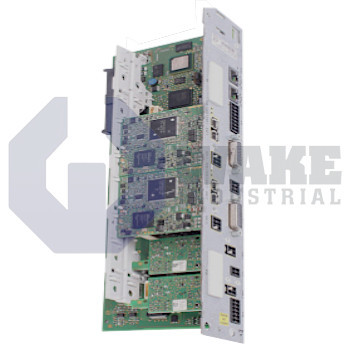
CDB02.1B-ET-EC-EC-EC-NN-NN-NN-NN-AW Bosch Rexroth Indramat
Wake Industrial LLC is not an authorized distributor of this product.
MPN: R911391397
No Tariffs On US Orders- Straightforward Pricing: No Rush Fees, No Credit Card Fees
Current response time:
4 Minutes
21 Seconds
The Bosch Rexroth Indramat CDB02.1B-ET-EC-EC-EC-NN-NN-NN-NN-AW is part of the CDB Control Units series and weighs 0.480 kg. It comes with 2 analog outputs, 14 digital inputs, and supports Multi-Ethernet communication compliant with IEEE 802.3. This unit features multi-encoder interfaces for both axis 1 and axis 2, an advanced control panel, and 32 kB FRAM retain memory.


To contact sales for pricing and lead time:
Payment Methods


Shipping Methods


Our Credentials


Product Description:
The CDB02.1B-ET-EC-EC-EC-NN-NN-NN-NN-AW is a modular control unit produced by Bosch Rexroth Indramat within the CDB Control Units series. Designed for multi-axis drive tasks, the unit forms the command layer that links servo inverters with higher-level PLCs in industrial automation cells. It coordinates motion, processes feedback, and routes fieldbus traffic for synchronized positioning and speed regulation on two axes. The housing follows the format of second-generation IndraDrive controllers and installs directly on a DIN rail inside the drive cabinet.
I/O and network capacity are matched to mid-range machinery requirements. The control board provides 2 analog outputs for drive-related process signals and accepts 14 digital inputs for limit switches, probes, or mode selection. Communication is handled through a Multi-Ethernet interface that supports protocols defined by the IEEE 802.3 standard. For deterministic motion control over EtherCAT, the incoming channel is assigned to port X25 P1, and the daisy-chain continuation leaves on port X24 P2. Both axis channels share a Multi-Encoder Interface, so Axis 1 and Axis 2 can read incremental, EnDat, or SSI feedback devices without additional daughter cards. An extra Multi-Encoder Interface socket is present for gantry or master-slave configurations. Local setup is performed through the Advanced control panel, which provides graphical parameter access and real-time diagnostic menus.
Internal resources complete the platform’s integration role. There are 4 optional slots that accept safety, I/O expansion, or fieldbus cards when the base feature set needs to be extended. Non-volatile storage of parameter sets and counter values is secured by 32 kB FRAM retain memory, eliminating battery maintenance. Both dedicated safety channels are not installed, so external safe torque-off modules must be added if required by the risk assessment. Despite its feature density, the unit weighs only 0.480 kg, which simplifies cabinet layout and reduces load on DIN-rail hardware.









