


BTA20.3-NC-DA-BA-BS Bosch Rexroth Indramat
Wake Industrial LLC is not an authorized distributor of this product.
- Straightforward Pricing: No Rush Fees, No Credit Card Fees
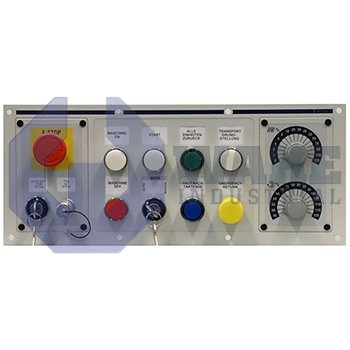
The Bosch Rexroth Indramat BTA20.3-NC-DA-BA-BS is part of the BTA20 Machine Control Boards series and features a data width of 48 bits. This control board is equipped with 8 external 24 V inputs and 8 external 24 V outputs, with output current per output up to 200 mA. The device has a front panel with IP65 protection and provides 2 Interbus ports for communication.


To contact sales for pricing and lead time:
Payment Methods


Shipping Methods


Our Credentials


Product Description:
The BTA20.3-NC-DA-BA-BS is a machine control board produced by Bosch Rexroth Indramat within the BTA20 Machine Control Boards series. Designed for installation in modular automation racks, the board acts as a communication and I/O hub that links Indramat drives with higher-level numerical control equipment. By combining digital fieldbus handling, local 24 V signal processing, and serial diagnostics on a single card, it simplifies wiring in machining centers, printing lines, and other discrete manufacturing systems.
The controller’s data path is 48 bits wide, allowing simultaneous transfer of three 16-bit process words for low-latency motion commands. Protection on the aluminum front plate is rated at IP65, so the unit can be mounted behind sealed viewports without exposing electronics to dust or coolant spray. Mechanical depth is 119 mm, while the total width of 407 mm fits standard Euro-format subracks. The board provides eight external 24 V input channels and eight matching output channels, and each output can source up to 200 mA for direct control of contactors or optical sensors. Two Interbus remote-bus ports run at 500 kbaud and identify themselves to the network with Id-code 3, permitting one additional BTA board to be daisy-chained. One RS232 service port and a pair of RS422 ports support serial diagnostics and NC status reporting.
The vertical outline of the card is 169 mm, and internal conductor routing accommodates a total of 40 Interbus input bits and 24 Interbus output bits exchanged with the master during each cycle. Because the external I/O mirrors these values, the CPU can map sensor states to bus telegrams without additional gateways. Limiting the configuration to one linked BTA unit and two fieldbus ports reduces token pass delays, while the 8 input and 8 output 24 V terminals remain galvanically isolated from logic power to minimize ground loops during multi-axis operation.
Frequently Asked Questions about BTA20.3-NC-DA-BA-BS:
Q: How many external 24 V inputs are available on the BTA20.3-NC-DA-BA-BS board?
A: This model offers 8 external 24 V inputs for connecting external devices or sensors.
Q: How many external 24 V outputs does the BTA20.3-NC-DA-BA-BS support?
A: The BTA20.3-NC-DA-BA-BS provides up to 8 external 24 V outputs for controlling other equipment.
Q: What is the output current rating per output channel on the BTA20.3-NC-DA-BA-BS?
A: Each output on this board can supply a current of up to 200 mA.
Q: What is the front panel protection rating of the BTA20.3-NC-DA-BA-BS?
A: This product features a front panel protection rating of IP65, offering strong protection against dust and water.
Q: How many Interbus ports are provided on the BTA20.3-NC-DA-BA-BS control board?
A: The BTA20.3-NC-DA-BA-BS is equipped with two Interbus ports for fieldbus communications.