


BTA20.2 Bosch Rexroth Indramat
Wake Industrial LLC is not an authorized distributor of this product.
- Straightforward Pricing: No Rush Fees, No Credit Card Fees
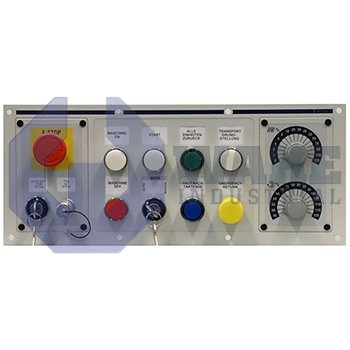
The Bosch Rexroth Indramat BTA20.2 is part of the BTA20 Machine Control Boards series and features 48 total inputs and 24 total outputs. This control board provides 3 acknowledge circuits, 2 emergency stop circuits, and supports a bus speed of 500 Kbaud with a 30-pin socket. It has IP65 front protection and IP20 housing protection, and operates at a maximum temperature of 45°C.


To contact sales for pricing and lead time:
Payment Methods


Shipping Methods


Our Credentials


Product Description:
The BTA20.2 is a machine control board manufactured by Bosch Rexroth Indramat for the BTA20 Machine Control Boards series. It plugs into an Interbus-S remote I/O station and provides discrete signal handling so a higher-level PLC can monitor and actuate field devices without extra interface hardware. By combining digital inputs, digital outputs, and safety loops on one card, the board streamlines installation in automated assembly lines, packaging equipment, and material transport systems. This arrangement helps centralize machine signals at the I/O station while keeping response paths direct and organized.
The module exchanges process data over the fieldbus at 500 Kbaud, and each telegram carries a 48-bit I/O image. This layout lets the controller read status signals and return output commands through one bus node instead of separate interfaces. All input channels operate at 24 V, while the backplane can furnish up to 50 mA of bus-supplied +5 V for sensors or signal conditioning. A front connector with 30 socket pins routes the control lines to terminal blocks or prefabricated cables. The board also reports an Interbus-S ID code of 3 and supports three separate acknowledgment lines for reliable handshaking during bus operation.
The front panel has an IP65 protection rating, which suits dusty areas and washdown-prone cabinet doors, while the housing behind the panel has an IP20 rating because it remains inside the enclosure. Operation is permitted at ambient temperatures up to +45 °C without derating. Up to 8 plug-in components can be installed to tailor the signal arrangement, and each component can use the standard 22.5 mm width with as many as two contacts. The I/O section supports a total of 48 inputs and 24 transistor outputs, and two dedicated emergency-stop circuits provide shutdown paths for the machine.
Frequently Asked Questions about BTA20.2:
Q: What is the bus speed of the BTA20.2 machine control board?
A: The BTA20.2 offers a bus speed of 500 Kbaud for data communication.
Q: What level of front protection does the BTA20.2 provide?
A: The BTA20.2 features front protection rated at IP65 for dust and water resistance.
Q: How many inputs and outputs does the BTA20.2 board support?
A: This control board supports a total of 48 digital inputs and 24 digital outputs.
Q: What is the I/O voltage level on the BTA20.2 control board?
A: The BTA20.2 operates with a 24 V I/O voltage level.
Q: What is the maximum operating temperature for the BTA20.2?
A: The maximum allowable operating temperature for the BTA20.2 is +45°C.