

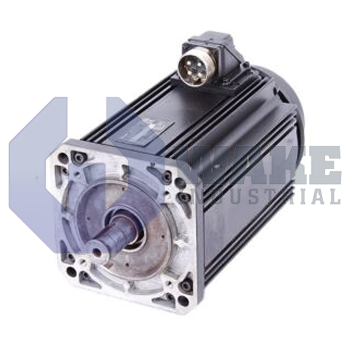
2AD160C-B35RB1-BS03-A2N1 Bosch Rexroth Indramat
Wake Industrial LLC is not an authorized distributor of this product.
MPN: R911238176
No Tariffs On US Orders- Straightforward Pricing: No Rush Fees, No Credit Card Fees
Current response time:
5 Minutes
43 Seconds
The Bosch Rexroth Indramat 2AD160C-B35RB1-BS03-A2N1 belongs to the 2AD 3-Phase Induction Motors series and is a synchronous AC servo motor. It features a rated power of 22 kW and operates at a rated speed of 1500 rpm. The motor offers an IP65 enclosure, an axial fan cooling system, and a resolver for feedback control.


To contact sales for pricing and lead time:
Payment Methods


Shipping Methods


Our Credentials


Product Description:
The 2AD160C-B35RB1-BS03-A2N1 Induction Motor is produced by Bosch Rexroth for various applications in industrial automation systems. It delivers a nominal power output of 37 kW. The motor develops a rated torque of 236 Nm under continuous load. The thermal management is optimized by a time constant of 65 minutes over repeated cycles.
The electrical supply to the 2AD160C-B35RB1-BS03-A2N1 induction motor must provide a nominal current of 90 Aeff. The specified nominal voltage is 299 Veff for stable supply conditions. A controlled dynamic response during acceleration and braking is achieved through a rotor inertia of 0.229 kgm². A nominal speed of 1500 min⁻¹ ensures steady operation in demanding tasks. The peak speed capacity of 6000 min⁻¹ supports short acceleration phases. The connection must be made with cables of at least 35 mm² cross-sectional area to ensure safety. The 2AD160C-B35RB1-BS03-A2N1 induction motor integrates noise and vibration limits effectively. The insulation system of the device is made according to class F DIN VDE 0530 Teil 1. It supports maximum ambient operational temperature conditions between 0 and 45 °C. The vibration severity falls within DIN ISO 2373 classifications R, S, and S1. The motor body without brake and blower weighs 240 kilograms.
The 2AD160C-B35RB1-BS03-A2N1 induction motor features a holding brake system, released through electrical actuation and rated for 24 V ±10%. Its braking system is capable of absorbing 40000 Ws of energy at a determined speed. Its consistent torque and speed values support machining and automation operations. The electrical and mechanical interface is designed for heavy industrial environments. The controlled inertia levels help achieve accurate start and stop sequences. The addition of the brake and blower brings the combined mass to 245 kilograms. The brake assembly alone contributes 5 kg to the system mass.
Frequently Asked Questions about 2AD160C-B35RB1-BS03-A2N1:
Q: What integration considerations exist for 2AD160C-B35RB1-BS03-A2N1 induction motor?
A: The 2AD160C-B35RB1-BS03-A2N1 induction motor integrates seamlessly with automation controllers but requires shielded encoder feedback cabling to prevent electromagnetic interference during synchronized multi-axis operations.
Q: How does 2AD160C-B35RB1-BS03-A2N1 induction motor behave under overload?
A: During overload scenarios, the 2AD160C-B35RB1-BS03-A2N1 induction motor sustains mechanical integrity; however, continuous overcurrent triggers thermal sensor trips affecting duty cycle and recovery times.
Q: Which auxiliary systems enhance 2AD160C-B35RB1-BS03-A2N1 induction motor performance?
A: Performance of the 2AD160C-B35RB1-BS03-A2N1 induction motor improves with external forced ventilation units, ensuring consistent torque delivery under extended high-speed cycles in machining and conveyor applications.
Q: What control implications arise from 2AD160C-B35RB1-BS03-A2N1 induction motor inertia?
A: The controlled inertia of the 2AD160C-B35RB1-BS03-A2N1 induction motor requires adaptive drive tuning for rapid deceleration, reducing overshoot while maintaining stability in dynamic industrial positioning systems.
Q: How does braking energy affect 2AD160C-B35RB1-BS03-A2N1 induction motor use?
A: The 2AD160C-B35RB1-BS03-A2N1 induction motor’s brake absorbs kinetic energy; in repetitive stop cycles, energy dissipation requires external braking resistors to prevent thermal overload within braking modules.









