

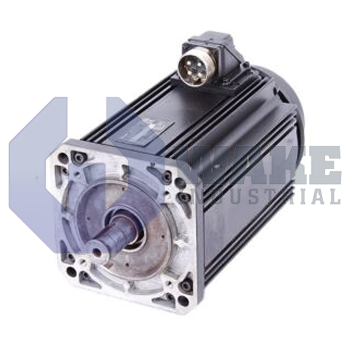
2AD132D-B05OB2-AS03-D2N3 Bosch Rexroth Indramat
Wake Industrial LLC is not an authorized distributor of this product.
MPN: R911279821
No Tariffs On US Orders- Straightforward Pricing: No Rush Fees, No Credit Card Fees
Current response time:
5 Minutes
12 Seconds
Bosch Rexroth Indramat AC Motor in the 2AD Series. This Motor is an Asynchronous Motor Type that has a Motor Size of 132, and a Motor Length of D."


To contact sales for pricing and lead time:
Payment Methods


Shipping Methods


Our Credentials


Product Description:
With a 3-pole design ensuring a fast speed of rotation, the 2AD132D-B05OB2-AS03-D2N3 from Rexroth comes with an output speed ranging from 1500 to 7500 rpm. This AC servo motor is perfect for applications where speed and torque are in high demand, as it comes with a nominal torque rating of 140 Nm, while the maximum torque generated by this servo motor is around 167 Nm. This servo motor comes with a current draw of around 54 amperes while operating at an operational voltage of 290 volts AC.
Since this motor is used in applications such as robotics, the servo motor relies on high-resolution feedback systems, where it uses a digital encoder interface to communicate with a motor controller over a serial data line with a motor control module that is compatible with this motor model. This motor, when connected through a DCS system, can be controlled via a local network over a network system using a Network card.
To ensure this servo motor retains position data in the case of power loss, the motor controller can provide the required data; however, the encoder module does feature ROM data to save the current shaft position, helping the motor shaft move back to its last known position. Users can choose between a single-turn or multiturn configuration of the encoder, depending on the application this servo motor is being used for. This encoder will require around 5 volts DC to operate and draws around 28 mA of current to power up. The encoder works by generating square wave pulses whenever an increment or step point is detected, registering the data of the 5 volts peak for the square wave in the memory, which is then used to calculate the final and current position of the shaft.









