


Navigating the 2025 Auto Tariff Revisions: A New Era for U.S. Manufacturing and Automation
8 May, 2025 | 2025, Tariffs, Tariff, Tariffs Update, Auto Tariffs, Manufacturing Tariffs, Tariff Engineering, China, China Tariffs, bosch tariffs, Indramat, tariff exclusion
Navigating the 2025 Auto Tariff Revisions: A New Era for U.S. Manufacturing and Automation
UPDATE: As of 5/8/23 The US and The UK have reached a deal to lower the tariff on British Automobiles to 10%.
UPDATE: As of 5/12/25 The US has has reduced Tariffs on most Chinese products from 145% to 30% and China has cut down Tariffs on US goods from 125% to 10% for the next 90 days. During the next 90 days both countries will continue to discuss potential trade deals.
UPDATE: As of 5/21/25 Tensions have risen again as the US states that anyone using semiconductor chips from Huawei Technologies violates US export controls. China has threatened legal action to anyway enforcing the US restrticio
To learn more on the broader Tariff Situation be sure to read our intial blog on Tariffs in The Automation Sector
In late April 2025, the White House announced a series of adjustments to the 25 percent tariff on imported automobiles that have dominated headlines and boardroom discussions for months. Facing pressure from Detroit, foreign automakers with U.S. plants, and parts suppliers bracing for skyrocketing costs, the Trump administration opted for a calibrated easing rather than a full repeal. While the base tariff on foreign‐made cars remains intact, new credits for U.S. assembly, anti-stacking rules, and North American content incentives all aim to soften the blow on domestic production lines. At the same time, retaliatory measures from the European Union and China loom large, threatening to hamper U.S. exports. For engineers, plant operators, and business owners, these policy shifts demand swift operational pivots—especially in an era when automation technologies like Bosch Rexroth Indramat drives play a critical role in maintaining factory efficiency.
As uncertainty rises, it becomes increasingly important to have a reliable maintenance plan for your legacy equipment. Wake Industrial offers exhaustive repair, refurbishment, and replacement options for legacy Bosch Rexroth products and other manufacturers. To learn how Wake Industrial can be part of your maintenance plan call 1-919-443-0207 or fill out the quote form embedded on this page.
Easing the Immediate Shock
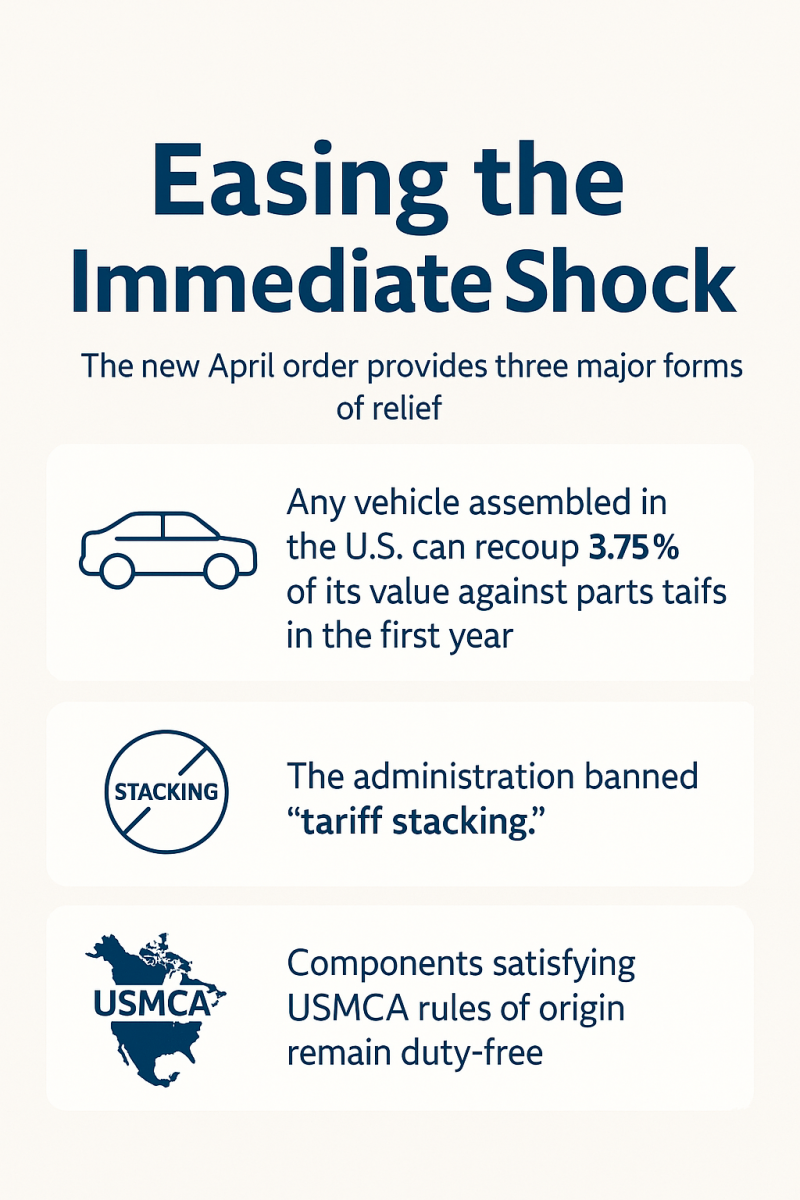
When the 25 percent auto tariff first took effect in early 2025, its impact was immediate: suppliers warned of cost increases of $3,000 to $6,000 per imported vehicle, and some automakers halted production of certain models destined for U.S. showrooms. The new April order provides three major forms of relief. First, any vehicle assembled in the United States can recoup 3.75 percent of its value against parts tariffs in the first year, dropping to 2.5 percent in year two. In practical terms, a car with 85 percent U.S. or USMCA-region content pays little to no net tariff on its components during that period—granting automakers crucial breathing room.
Second, the administration banned “tariff stacking.” Where previously an imported steel-framed component might incur a 25 percent auto tariff plus 25 percent steel and aluminum duties, now only the higher of the two rates applies. This change alone can shave hundreds of dollars off high-value parts. Lastly, components that satisfy USMCA’s rules of origin—meaning they come from the United States, Canada, or Mexico—remain duty-free, effectively rewarding regional supply chains that were already in place.
Rethinking Supply Chains and Production Lines
For procurement teams and design engineers, the ripple effects began almost instantly. Sourcing managers revisited every bill of materials, weighing the cost of a German-made transmission against the logistical and financial benefits of a nearby U.S. supplier. In some cases, parts once imported from Asia are now being qualified from plants in Mexico or even on U.S. soil, ensuring they count toward the credit threshold. Meanwhile, product engineers are experimenting with so-called “tariff engineering”: breaking complex assemblies into subcomponents so that the final U.S. assembly captures more value domestically and minimizes duties.
Automakers, too, are adjusting where they build entire vehicles. Foreign brands with U.S. plants—such as BMW in South Carolina and Toyota in Texas—have signaled plans to shift more of their U.S.-bound models to American assembly lines. General Motors and Ford, whose high-volume trucks already meet the U.S.-content targets, suddenly boast an edge: their domestically produced vehicles can avoid tariffs entirely, allowing them to market “Made in USA” trims as both patriotic and cost-competitive alternatives to imports.
On the other hand, smaller volume models with low regional content may become candidates for discontinuation in the U.S. market or carry significantly higher sticker prices. Dealers are bracing consumers for moderate price hikes—4 to 6 percent on certain imports—rather than the 25 percent jump once feared. Consumers, meanwhile, are weighing “buy American” messaging against the prestige or desirability of foreign-badged nameplates.
The Consumer’s Bill and the Aftermarket
The new policy’s design helps blunt the worst consumer pain, but it does not eliminate it. Imported cars still face a full 25 percent duty at the border, and any vehicle with under-threshold domestic content will have to absorb some portion of that cost. Automakers are using a mix of rebates, price adjustments, and marketing incentives to ease the sting, but shoppers should expect incremental price increases on many popular models. At the same time, the aftermarket segment—spare parts, repair shops, and collision centers—faces its own challenges. Replacement components that fall outside the April relief, such as specialized foreign-made sensors or body panels, will carry the 25 percent tariff. This drives up repair bills and pushes fleet operators to consider domestic or remanufactured alternatives when available.
Global Ripples: EU and China
No discussion of U.S. tariffs is complete without considering international responses. In Brussels, the European Union had threatened 25 percent counter-tariffs on $21 billion of U.S. exports, ranging from bourbon to SUVs. In a symbolic thaw, EU leaders agreed in April to suspend their measures for 90 days, instead imposing a modest 10 percent reciprocal tariff on U.S. goods. The truce provides a window to negotiate a longer-term accord, but the specter of full EU retaliation looms if talks falter. Likewise, China struck back with sweeping 125 percent duties on U.S. auto exports and crucial raw materials—most notably rare-earth magnets indispensable for electric vehicle motors and factory robots. That dramatic increase has effectively blocked American-built cars from the world’s largest auto market and spurred U.S. manufacturers to seek alternate sources of strategic minerals.
Automation Sector Dynamics
As automakers revamp supply chains and production footprints, their factory automation partners are riding the wave—both lifting it and feeling its friction. On one hand, the push to onshore more manufacturing triggers fresh capital expenditures in robotics, conveyors, and CNC equipment. A new engine assembly line in Ohio or a refreshed stamping plant in Michigan will demand high-precision motion control, much of it supplied by firms like Bosch Rexroth Indramat. The German-engineered Indramat drives—renowned for their reliability in welding, painting, and powertrain assembly cells—are poised for increased demand as plants modernize.
Conversely, the import duties on industrial machinery have climbed, too. A universal 10 percent baseline tariff on all import categories, plus additional sector-specific levies, now applies to factory robots and CNC lathes. Steel and aluminum duties add another 25 percent on machine frames. For automation integrators, this means higher equipment costs and lengthened lead times at customs. The result is a renewed emphasis on local sourcing, aftermarket support, and creative solutions: shops are refurbishing existing equipment, extending the life of legacy machines through software upgrades and controls retrofits, and stocking spare parts domestically to sidestep tariff delays.
Bosch Rexroth itself has responded by expanding regional manufacturing. Its 2023 investment in a state-of-the-art Querétaro facility in Mexico reflects a strategic bet: serving the North American market with minimal tariff exposure and faster delivery. Such moves help keep Indramat drives, linear motors, and hydraulic systems flowing to U.S. plants with fewer import headaches. Wake Industrial serves as a reliable aftermarket source for Bosch Rexroth Indramat products. Wake Industrial can repair or replace a wide variety of Indramat products. To get the support you need call Wake Industrial at 1-919-443-0207 or fill out the quote form above.
Practical Steps for Industry Stakeholders
For engineers and procurement teams, the message is clear: design with trade policy in mind. When specifying components, consider total landed cost—not just list price. Source from U.S. or USMCA-qualified suppliers wherever possible, and structure assemblies to capture credit-eligible value in final U.S. assembly. Business leaders must run scenario analyses for each model line: evaluate the cost trade-off of localizing production versus absorbing tariffs, and be prepared to adjust pricing, marketing, and product portfolios accordingly.
On the factory floor, plant operators should bolster spare-parts inventories of critical automation components—especially German drives or Japanese robot arms—and work with regional distributors for faster turnaround. Maintenance teams can explore refurbished parts to bridge short-term gaps, while long-term plans might include investing in in-house repair capabilities and software upgrades to extend the life of existing machinery.
Looking Ahead
These tariff revisions represent a strategic compromise: they preserve protectionist leverage to encourage domestic manufacturing while granting targeted relief to prevent immediate economic shock. Whether they succeed in catalyzing a more resilient North American auto ecosystem remains to be seen. What is clear is that flexibility will be the cornerstone of success. Companies that can pivot supply chains, adapt factory footprints, and leverage automation smartly—turning Indramat drives and other advanced systems into competitive advantages—will emerge best positioned for a trade-uncertain future. Amid global tit-for-tat tariffs and shifting consumer expectations, the intersection of policy, production, and technology is where the next chapter of the U.S. automotive renaissance will be written.
Wake Industrial is your partner in progress. Whether you're navigating new tariff pressures or modernizing your automation infrastructure, our expert team provides reliable repair, refurbishment, and replacement services for legacy Bosch Rexroth Indramat systems. Call Wake Industrial today at 1-919-443-0207 or complete the quote request form on this page to keep your production lines running efficiently—no matter how the global landscape shifts.
Request a Quote

Cary, NC 27513












