


EEA-PAM-553-D-32EN27 Vickers
Wake Industrial LLC is not an authorized distributor of this product.
Wake Industrial LLC is not an authorized distributor of this product.
- Straightforward Pricing: No Rush Fees, No Credit Card Fees
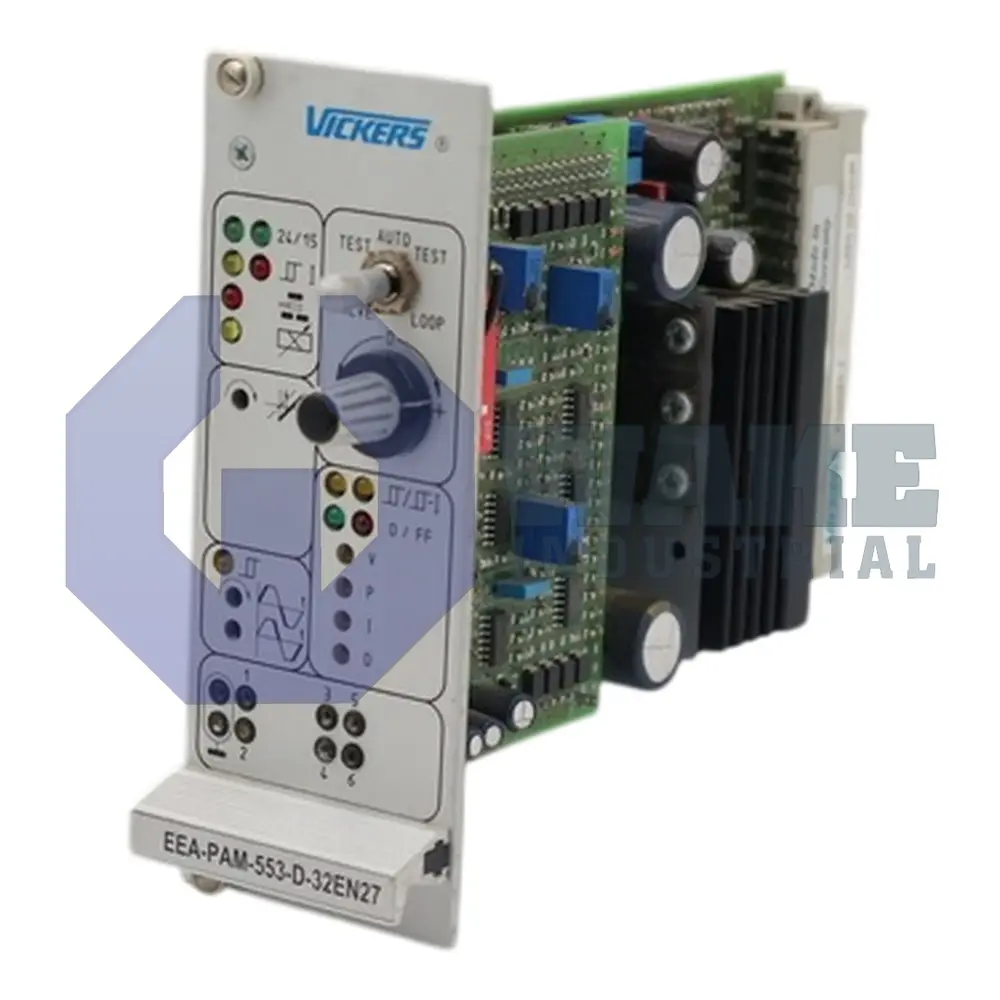
The Vickers EEA-PAM-553-D-32EN27 is a power amplifier from the EEA-PAM Power Amplifiers series. It operates with a 24 V DC power supply and has a card height of 3U. The amplifier uses a DIN 41612 F48 male card connector and has a mass of 0.4 kg, with positive and negative reference outputs of +10 V and -10 V.


To contact sales for pricing and lead time:
Payment Methods


Shipping Methods


Our Credentials


Product Description:
The EEA-PAM-553-D-32EN27 is a plug-in power amplifier card manufactured by Vickers within the EEA-PAM Power Amplifiers series. The board mounts in a 19-inch rack and interfaces with proportional or servo hydraulic valves, translating low-level control commands from a PLC into the regulated current required for precise spool positioning. By converting logic-level signals into valve drive currents and returning diagnostic information, the module supports closed-loop pressure or flow regulation in automated machinery.
The module operates from a 24 V DC cabinet supply and internally generates a regulated +15 V rail for downstream electronics. A matched pair of reference outputs delivers +10 V at 5 mA and -10 V at 5 mA for external command potentiometers. Command channels are protected by a 100 Ω current-input impedance and a 47 kΩ voltage-input impedance that limit source loading. Ramp and monitor pins each present an impedance of 10 kΩ, while the digital enable path draws 10 mA when asserted. Alarm signaling is provided through a solid-state output rated for 50 mA, allowing direct connection to indicator lamps or PLC status points. Sensor feedback inputs accept 100 Ω current loops or 1 MΩ voltage transducers.
Physical integration is handled by a DIN 41612 F48 male edge connector that mates with the Vickers backplane. The board follows the 3U Eurocard format, making it compatible with standard racks, and it weighs only 0.4 kg, minimizing the load on card guides. A dedicated feed-forward path with an impedance of 6 kΩ allows an open-loop bias signal to accelerate valve response without disturbing the main feedback loop. High-impedance monitor points and low-burden sensor voltage inputs are accessible from the front test jacks, allowing signal measurements during machine setup and tuning.









