

EEA-PAM-561-D-32 Vickers
Wake Industrial LLC is not an authorized distributor of this product.
- Straightforward Pricing: No Rush Fees, No Credit Card Fees
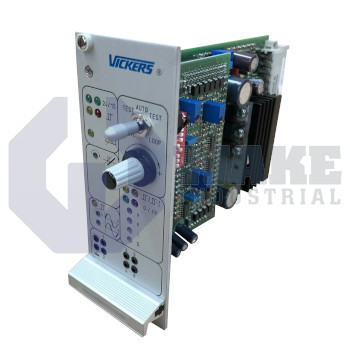
The EEA-PAM-561-D-32 power amplifier by Vickers offers precise PID control with ±10 V output signals and short-circuit protection. Its ramp generator supports a 5 kΩ load and delivers stable performance.


To contact sales for pricing and lead time:
Payment Methods


Shipping Methods


Our Credentials


Product Description:
The
The
This EEA-PAM-5**-D-32 power amplifiers series module’s ramp active indicator monitors the ramping status of the drive output to deliver precise feedback. When the drive ramps up, the output exceeds 10 V while ramping down results in an output below –10 V. If there is no ramping, the output stabilizes around 0 ± 10 V. The output resistance for the ramp status signal is maintained at 10 kΩ to ensure consistent and interference free readings.
Frequently Asked Questions about EEA-PAM-561-D-32:
Q: What happens during a solenoid overload in the Vickers EEA-PAM-561-D-32?
A: When a solenoid overload occurs, the output voltage drops to 0 to ±2 V. It remains in this state until manually reset, ensuring no uncontrolled reactivation.
Q: How does the Vickers EEA-PAM-561-D-32 maintain signal stability during ramping?
A: The EEA-PAM-561-D-32 uses a ramp active indicator to monitor drive output changes. During ramp-up, the output exceeds 10 V, while ramp-down drops below –10 V, stabilizing around 0 ±10 V when idle.
Q: What protection does the Vickers EEA-PAM-561-D-32 offer for short circuits?
A: This model provides short-circuit protection on its ±10 V analog outputs. It ensures reliable performance by maintaining a minimum load impedance of 10 kΩ to prevent disruptions or output failures.
Q: How does the alarm output system in the EEA-PAM-561-D-32 function?
A: The z12 alarm output activates 500 ms after power-on to indicate drive output status. If triggered, the output voltage equals the supply voltage minus 2 V, with a max output current of 50 mA.
Q: How does the EEA-PAM-561-D-32 ensure consistent feedback signal readings?
A: The feedback signal (d24) maintains an output resistance of 10 kΩ to prevent signal interference. This ensures precise and stable monitoring, critical for high-performance control system accuracy.