


SC322A-601-01 Pacific Scientific
Wake Industrial LLC is not an authorized distributor of this product.
- Straightforward Pricing: No Rush Fees, No Credit Card Fees
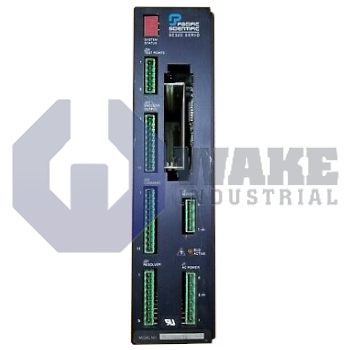
The Pacific Scientific SC322A-601-01 is part of the SC320 Command Controllers series and is designed for torque and velocity control. It supports 4-quadrant operation with a 3.8 amp continuous and 7.5 amp peak current rating, handling input voltages of 120 or 240 VAC. The controller features a resolver as primary feedback and provides 1024 ppr encoder output resolution with 12-bit RDC resolution.


To contact sales for pricing and lead time:
Payment Methods


Shipping Methods


Our Credentials


Product Description:
The SC322A-601-01 is a digital command controller manufactured by Pacific Scientific for the SC320 Command Controllers series. It supervises brushless servo axes in industrial automation by issuing torque or velocity references to the power stage and by interpreting real-time rotor feedback. In a multi-axis installation, the product sits between the motion processor and the drive, coordinating acceleration, deceleration, and steady-state speed so that packaging heads, web unwinders, or pick-and-place gantries can follow programmed profiles without drift.
The controller is configured for torque and velocity regulation, allowing it to switch between closed-loop torque mode for tensioning applications and velocity mode for constant-speed transport. A universal supply accepts 120/240 VAC, letting a single hardware type cover both domestic and international mains. Output capacity of 3.8 A continuous and 7.5 A peak supports medium-frame servomotors while leaving overhead for transient loads. Its 4-quadrant energy handling permits regenerative braking in either rotational direction without additional shunt components. Primary rotor position is obtained through a brushless resolver, and the controller creates an emulated encoder stream with a resolution of 1024 ppr so downstream PLCs can retain standard incremental interfaces.
Position quality is refined by an Rdc tracking accuracy of ±22 arcmin, which keeps phase error between the commanded vector and actual shaft angle low. Internally, resolver-to-digital conversion uses a 12-bit sample, giving 4096 discrete counts per electrical revolution. This conversion depth improves low-speed torque linearity and helps the control loop maintain smooth commutation during slow-speed operation. It also supports stable feedback processing during reversing motion and short indexing moves.









