


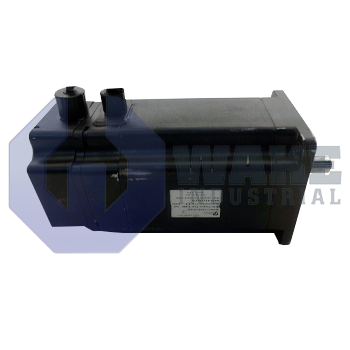
PMB33E-20100-02 Pacific Scientific
Wake Industrial LLC is not an authorized distributor of this product.
- Straightforward Pricing: No Rush Fees, No Credit Card Fees
Current response time:
3 Minutes
53 Seconds
The Pacific Scientific PMB33E-20100-02 is part of the PMB Brushless Servomotors series and is a NEMA Size 34 brushless servomotor. It features a resolver sensor, a square key shaft design, and flying leads with AMP connectors. This motor has a nominal stall current of 7.4 ARMS at 240 Vac maximum and includes a PTC thermistor for protection.


To contact sales for pricing and lead time:
Payment Methods


Shipping Methods


Our Credentials


Product Description:
The PMB33E-20100-02 is a brushless servomotor manufactured by Pacific Scientific and supplied within the PMB Brushless Servomotors series. As a rotary actuator, it converts drive currents into controlled torque and speed for indexing tables, pick-and-place axes, and other closed-loop motion tasks in automated equipment. The motor is intended to work with an external servo amplifier that regulates current based on resolver feedback, making it a core component of precise industrial automation systems. This arrangement allows the motion system to correct position and speed errors continuously during changing loads and repeated start-stop cycles.
Mechanical interface follows the NEMA Size 34 frame standard, so mounting holes and pilot diameter match common 5.63-inch square patterns. Power and signal wiring emerge as flying leads, each terminated by AMP connectors for direct mating to cabinet looms without additional breakout hardware. At a 240 Vac bus, the phase windings can withstand 7.4 ARMS of nominal stall current, which sets the allowable continuous current under stalled conditions. Rotor position is reported by a Resolver, providing absolute angle information over a full revolution even in electrically noisy environments. The keyed output shaft transmits torque through a Square Key, preventing slipping under peak load. These features support reliable coupling to common machine elements such as pulleys, couplings, and compact gear trains.
Thermal safeguarding is provided by a PTC Thermistor embedded in the stator, so the drive can reduce current or issue a fault when coil temperature rises too far. The laminated core uses a stack length multiple of 3, which increases active copper volume and supports higher continuous torque without changing the external dimensions. The published stall current rating presumes operation from 240 Vac, so axes powered from lower buses require adjusted current demand from the drive. The brushless architecture eliminates commutator wear and supports cleaner operation in particulate-sensitive environments. It also helps the motor maintain consistent electrical commutation during long duty cycles where repeatable response is important.









