


PMB33C-20200-02 Pacific Scientific
Wake Industrial LLC is not an authorized distributor of this product.
Wake Industrial LLC is not an authorized distributor of this product.
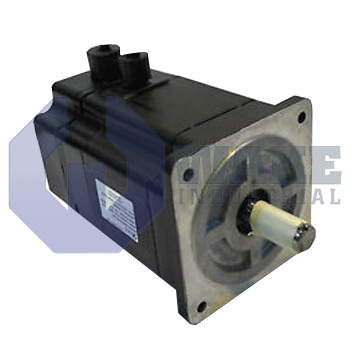
The Pacific Scientific PMB33C-20200-02 is a brushless servomotor from the PMB Brushless Servomotors series. It features a NEMA Size 34 frame and comes with a square key shaft design. This motor uses a resolver sensor and is equipped with flying leads with MS connectors.
Internal Product Review
The PMB33C-20200-02 is a Pacific Scientific PMB Series brushless servomotor in a NEMA Size 34 frame. Resolver feedback and a square key shaft give the motor accurate position response and secure power transmission. Flying leads with MS connectors and a PTC thermistor add installation convenience and valuable motor protection, making this unit an excellent fit for demanding servo applications.
 Have a part to sell?
 Wake Industrial Warranty
To contact sales for pricing and lead time:
Payment Methods


Shipping Methods


Our Credentials


Product Description:
The PMB33C-20200-02 brushless servomotor is supplied by Pacific Scientific and belongs to the PMB Brushless Servomotors series. As a rotary actuator, it converts electrical energy into controlled mechanical torque for indexing, positioning, and speed-regulation tasks in automated production cells. When paired with a compatible servo drive, the motor operates in a closed-loop system that responds quickly to command changes and helps maintain stable motion during repeated starts, stops, and speed changes. Its response characteristics are useful on axes that must change direction frequently without losing position control. This operating profile suits pick-and-place gantries, packaging lines, and light machine-tool axes where compact size and fast response are important.
The motor uses the NEMA Size 34 frame pattern, so the pilot diameter, bolt circle, and shaft height follow common size-34 mounting dimensions. This format also helps the motor fit standard brackets and machine plates used around size-34 installations. At 240 VAC, the windings draw a nominal stall current of 3.8 ARMS during stall operation. Rotor position feedback is supplied by a Resolver, which provides noise-resistant sine-cosine signals for speed and position loops in electrically busy equipment. Output torque is delivered through a shaft with a Square Key, which helps pulleys or couplings resist slippage during acceleration and deceleration.
Power and feedback conductors exit as Flying leads with MS connectors, which can reduce enclosure depth because no panel-mounted plug is required at the motor body. This cable arrangement can simplify routing where motor clearance is limited. A factory-installed PTC Thermistor embedded in the stator windings supplies temperature data to the drive for overload detection, and the signal can be used to limit current if winding temperature rises. A stack length multiplier of 3 increases active lamination height, which supports higher continuous torque without changing the external footprint.