


PMB33C-00216-02 Pacific Scientific
Wake Industrial LLC is not an authorized distributor of this product.
- Straightforward Pricing: No Rush Fees, No Credit Card Fees
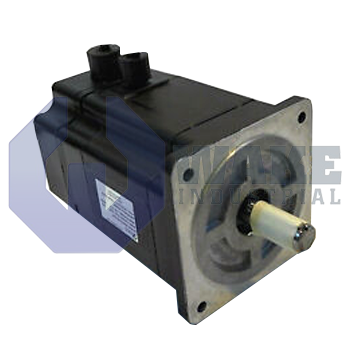
The Pacific Scientific PMB33C-00216-02 is a brushless servomotor from the PMB Brushless Servomotors series and features a NEMA Size 34 frame with a flat shaft design. It offers a nominal stall current of 3.8 ARMS at 240 Vac and has an encoder resolution of 4096 ppr. The servomotor is equipped with flying leads with MS connectors and a digital encoder with commutation.


To contact sales for pricing and lead time:
Payment Methods


Shipping Methods


Our Credentials


Product Description:
Pacific Scientific manufactures the PMB33C-00216-02 in its PMB Brushless Servomotors series. The unit is a brushless servomotor intended to deliver precise, closed-loop torque and speed control for pick-and-place heads, small conveyors, and indexing tables across automated lines. By integrating a digital feedback device and a compact stator, it supports dynamic positioning without the commutator wear found in brushed designs, and it can be powered from 240 VAC bus supplies used in modern servo drives.
Its frame follows the NEMA Size 34 outline, providing a 3.4-inch square mounting face that aligns with standardized motor brackets. Power and feedback lines exit through flying leads with MS connectors, which simplifies routing and allows the motor to connect to compatible harnesses without a separate terminal housing. When held at stall on a 240 VAC bus, the winding draws a nominal current of 3.8 ARMS, a value used to size the drive amplifier and evaluate thermal duty cycles. Rotor position is reported by a high-resolution 4096 ppr incremental channel, while phase alignment signals come from the integrated digital encoder with commutation, helping the drive maintain smooth torque at low speed and respond quickly to reversal commands.
A PTC thermistor is embedded in the stator to warn the controller of overheating before insulation limits are reached, and the signal can trigger automatic derating or shutdown. The lamination pack uses a stack length multiple of 3, boosting continuous torque without enlarging the mounting face. Output torque is transferred through a flat shaft, so coupling hubs with set screws lock against a machined land rather than a keyway, which helps limit radial runout. The internal arrangement leaves room for the thermal sensor and feedback hardware without increasing the face size.









