


PMB31D-10101-03 Pacific Scientific
Wake Industrial LLC is not an authorized distributor of this product.
- Straightforward Pricing: No Rush Fees, No Credit Card Fees
Current response time:
5 Minutes
14 Seconds
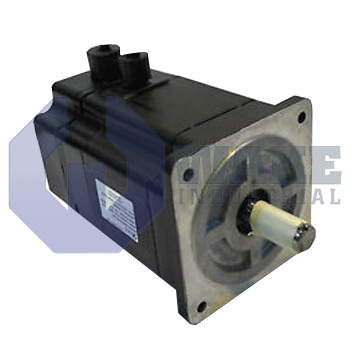
The Pacific Scientific PMB31D-10101-03 is a brushless servomotor from the PMB Brushless Servomotors series featuring a NEMA Size 34 frame and a round shaft design. It comes with flying leads with AMP connectors, and includes a shaft seal and PTC thermistor for added customization. The motor utilizes a Hall sensor and has a nominal stall current of 5.4 ARMS at 240Vac maximum.


To contact sales for pricing and lead time:
Payment Methods


Shipping Methods


Our Credentials


Product Description:
The PMB31D-10101-03 brushless servomotor is built by Pacific Scientific and belongs to the PMB Brushless Servomotors series. It is a permanent-magnet rotary actuator that delivers closed-loop torque and speed for automated machinery such as pick-and-place modules and indexing tables. Within production cells, it pairs with digital drives to position loads accurately while reducing brush wear compared to brushed motor designs. Its compact construction also supports quick response during coordinated multi-axis motion and helps it fit into tightly spaced machine layouts.
Electrical termination is supplied through flying leads with AMP connectors, which support straightforward harness routing because crimped contacts eliminate soldering. The motor uses a NEMA Size 34 frame, so its 3.4-inch square face mounts directly to standard motion platforms without adapter plates. Under a 240 V AC bus, the winding reaches its nominal stall limit at 5.4 ARMS, a value used to match the motor with a compatible drive for continuous holding torque at zero speed. Rotor position feedback comes from Hall sensors that provide commutation signals for trapezoidal current control. Mechanical power is transmitted through a round shaft, which works with clamp hubs or set-screw hubs in compact servo assemblies.
Application flexibility is expanded by the factory-applied shaft seal and PTC thermistor option. The seal helps limit contaminant entry and lubricant escape, while the thermistor monitors winding temperature so the drive can reduce output if the motor gets too hot. The electromagnetic package uses a stack length multiple of 1, which is the shortest core length in the series and helps keep rotor inertia low for rapid acceleration and deceleration. That shorter magnetic stack is useful on axes that need fast starts, short indexing moves, or frequent speed changes. The motor also shares common wiring colors and lead spacing with related PMB units, which supports consistent integration across multi-axis installations.









